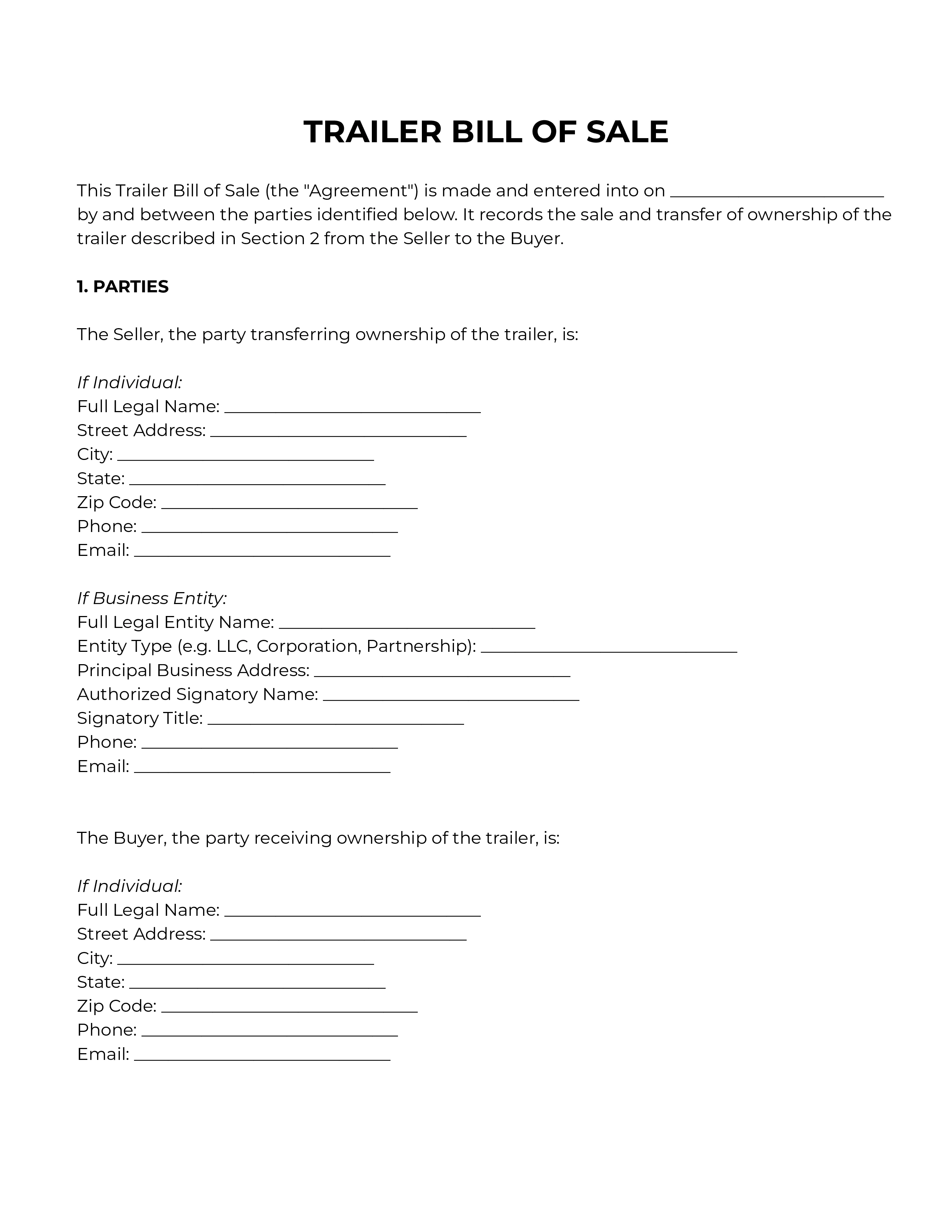
What is a Trailer Bill of Sale?
A Trailer Bill of Sale is a written record of the sale of a trailer between a seller and a buyer. It identifies the trailer, sets out the price and how it was paid, and confirms that ownership has passed from the seller to the buyer. The agreement also captures the condition the trailer is being sold in, any known issues the seller has disclosed, and the seller's confirmation that they have the right to sell it. For many trailer transactions — particularly private sales between individuals — the bill of sale is the primary document proving who owns the trailer, and it's often what the DMV asks for at registration.
When People Use It?
- Private sales of a trailer between two individuals
- Sales involving small businesses, sole traders, or partnerships
- Transfers of utility, cargo, flatbed, dump, travel, boat, horse, car hauler, or gooseneck trailers
- Sales of homemade or older trailers that may not have an existing title
- Online marketplace sales (Facebook Marketplace, Craigslist, local classifieds)
- Sales where the buyer needs proof of ownership for state registration or titling
Why People Use It?
- Creates a written record of the sale that both parties can rely on
- Provides the documentation most state DMVs ask for to register or title a trailer
- Records the condition the trailer was in at the time of sale, including any disclosed defects
- Documents that the trailer is sold as-is, which limits disputes about its condition after the sale
- Captures the seller's confirmation of ownership and lien status, giving the buyer a written record to point to if issues arise later
- Sets out a clear date when ownership and responsibility transferred
What the Template Gives You?
- Identification of both parties, with separate paths for individuals and business entities
- A complete trailer description block (year, make, model, type, VIN, color, axles, GVWR)
- Purchase price and payment details, with options for different payment methods and schedules
- A clear transfer-of-ownership date
- An as-is condition clause with standard warranty disclaimers
- Seller representations covering ownership, VIN match, theft and salvage status, and disclosure accuracy
- A buyer remedy clause if any of those representations turn out to be false
- Optional notary acknowledgement for states where notarisation is required or preferred
- A governing law clause and standard contract provisions (entire agreement, severability)