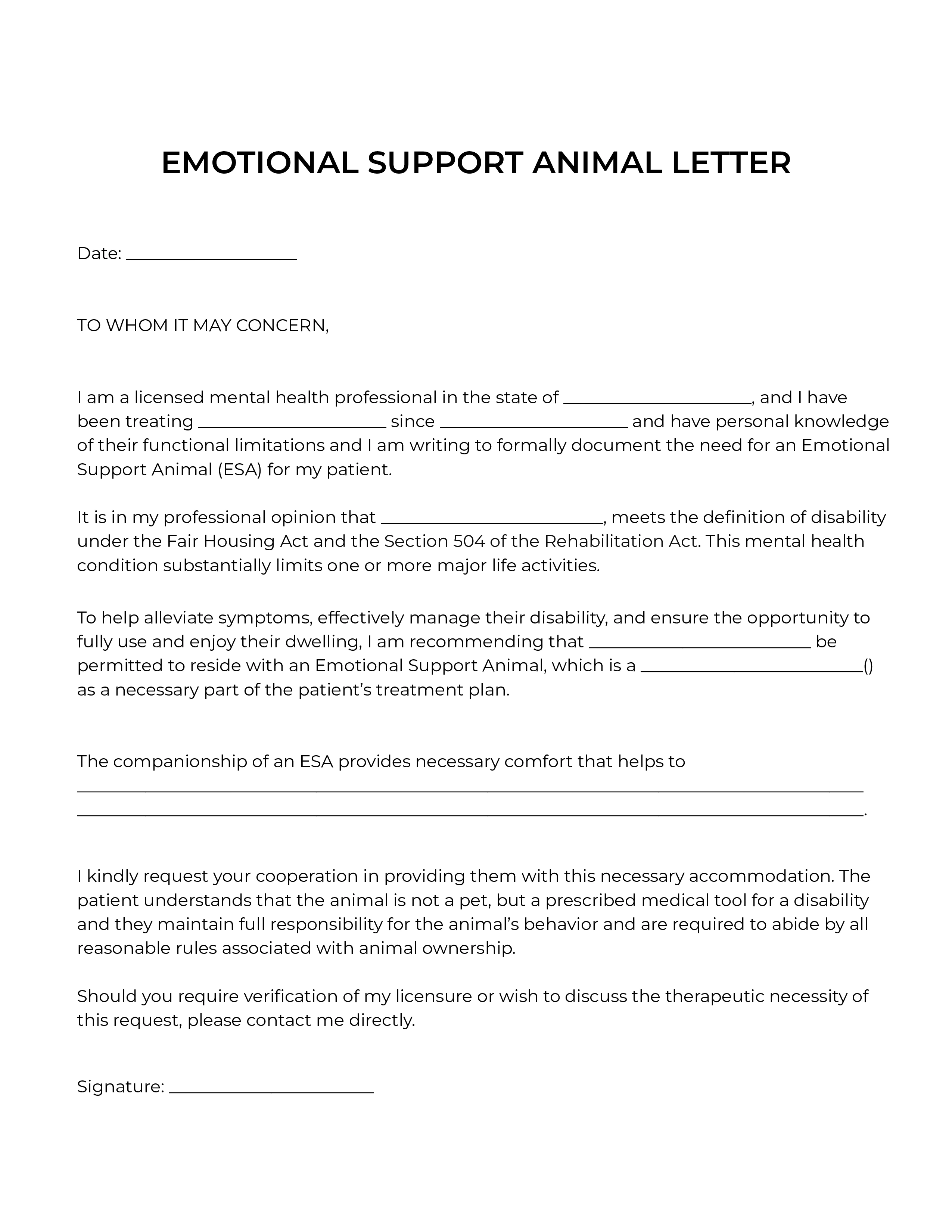
Emotional Support Animal Letter
What is an Emotional Support Animal Letter?
An Emotional Support Animal Letter is a written statement from a licensed mental health professional (LMHP) — such as a psychiatrist, psychologist, licensed clinical social worker, or therapist — recommending an emotional support animal as part of a patient's treatment. Unlike a service animal, which is individually trained to perform tasks for a person with a disability, an ESA provides comfort through companionship and isn't required to have specialized training. The letter typically connects the patient's condition to the recommended accommodation and references the framework housing providers work within, such as the Fair Housing Act and Section 504 of the Rehabilitation Act. Because the rules surrounding these letters vary by jurisdiction — including, in some states, a minimum clinician-patient relationship period — the template is written for completion by a licensed professional who can speak to the specifics.
When People Use It?
- A licensed mental health professional documenting an ESA recommendation for a patient.
- Supporting a patient's reasonable-accommodation request to a housing provider.
- Providing documentation when a landlord asks for verification of an ESA.
- Recording the clinical relationship and licensure details alongside the recommendation.
Why People Use It?
- It comes from the licensed professional best positioned to speak to the patient's condition and treatment.
- It captures the elements housing providers commonly look for, reducing follow-up requests.
- It keeps the clinical recommendation and the licensure and attestation details together in one document.
- It references the legal framework — the Fair Housing Act and Section 504 — that housing providers operate within.
What the Template Gives You?
- The date and a general "To Whom It May Concern" salutation.
- An introduction of the professional, their licensing state, and the length of the treating relationship.
- A statement, in the professional's opinion, addressing the patient's condition in relation to the Fair Housing Act and Section 504 of the Rehabilitation Act.
- The recommendation that the patient be permitted to reside with an ESA, with room to identify the animal.
- Space to describe how the animal's companionship supports the patient.
- A statement of the patient's responsibility for the animal's behavior and compliance with reasonable rules.
- An invitation for the recipient to verify licensure or discuss the recommendation.
- A signature block with the professional's name, license number, license type, practice, contact number, and address.
- A clinical relationship attestation, including a minimum 30-day relationship statement, license effective and expiration dates, and jurisdiction.