What is a Durable Power of Attorney?
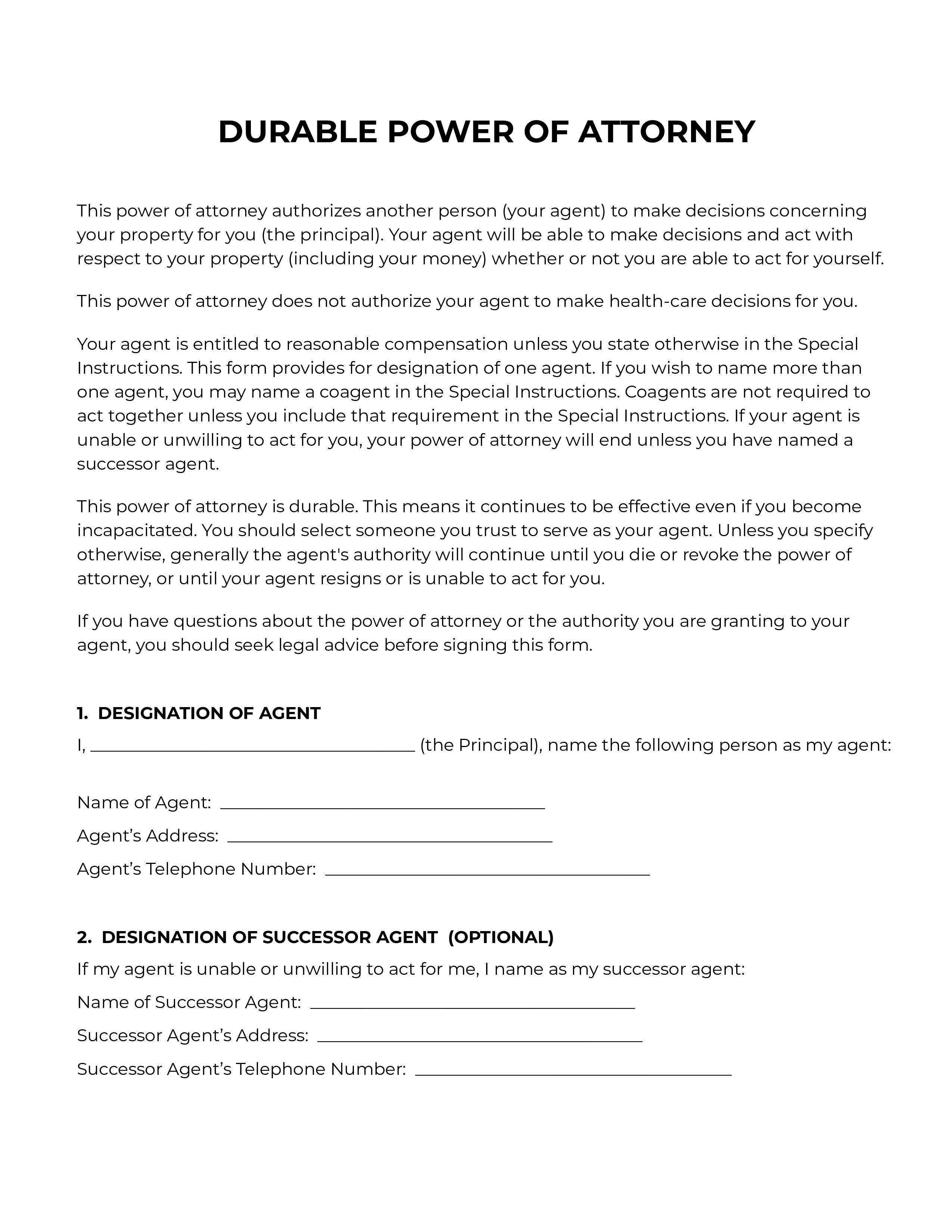
A durable power of attorney is a legal document in which one person (the principal) grants another person (the agent, sometimes called an attorney-in-fact) authority to act on their behalf in financial and property matters and where the authority continues even if the principal later becomes incapacitated and unable to manage their own affairs.
The principal decides how broad the authority is. It can cover some or all subject areas — banking, real estate, taxes, investments. It does not cover health-care decisions, which are handled through a separate medical or health-care directive. The authority lasts until the principal revokes it, dies, or a stated ending event occurs.
When People Use It
A durable power of attorney comes up in a range of situations, including:
- Incapacity planning, so a trusted person can manage finances if illness, injury, or age-related decline makes self-management difficult.
- Aging and estate planning, often alongside a will, trust.
- Periods of absence, such as military deployment or extended travel, when someone needs another person to handle property or accounts.
- Ongoing financial management, where a principal wants help with day-to-day matters like paying bills, managing investments, or handling real estate.
Why People Use It
- Continuity through incapacity. The defining feature — authority that survives loss of capacity — avoids a gap when the principal can no longer act alone.
- Avoiding court intervention. With authority already in place, families may not need to ask a court to appoint a guardian or conservator.
- Control over who acts and how. The principal chooses the agent, defines the scope, and can attach special instructions.
- Flexibility in timing. The authority can take effect immediately or only upon incapacity (a "springing" power), depending on how much control the principal wants to retain in the meantime.
What the Template Gives You
- A power of attorney drafted to follow the Uniform Power of Attorney Act, a model law adopted in many states to standardize how an agent's authority is granted and exercised.
- A complete designation of the agent, with optional successor agent if the first is unable or unwilling to serve.
- A grant of general authority across standard subject areas, plus separate "hot powers" (gifts, beneficiary changes, survivorship rights, trust changes) that carry greater estate impact.
- A durability provision confirming the authority continues through incapacity.
- An effective-date choice between immediate and springing power, with a method for confirming incapacity.
- A special-instructions section for co-agents, duty modifications, marriage-dissolution carve-outs, compensation terms and other custom terms.
- An optional guardian/conservator nomination covering both the estate role and the personal-care role.
- Execution blocks — signature, notary acknowledgment, witness attestation, and agent's acknowledgment.
- A governing-law field tying the document to a chosen state's statute.