What is a Limited (Special) Durable Power of Attorney?
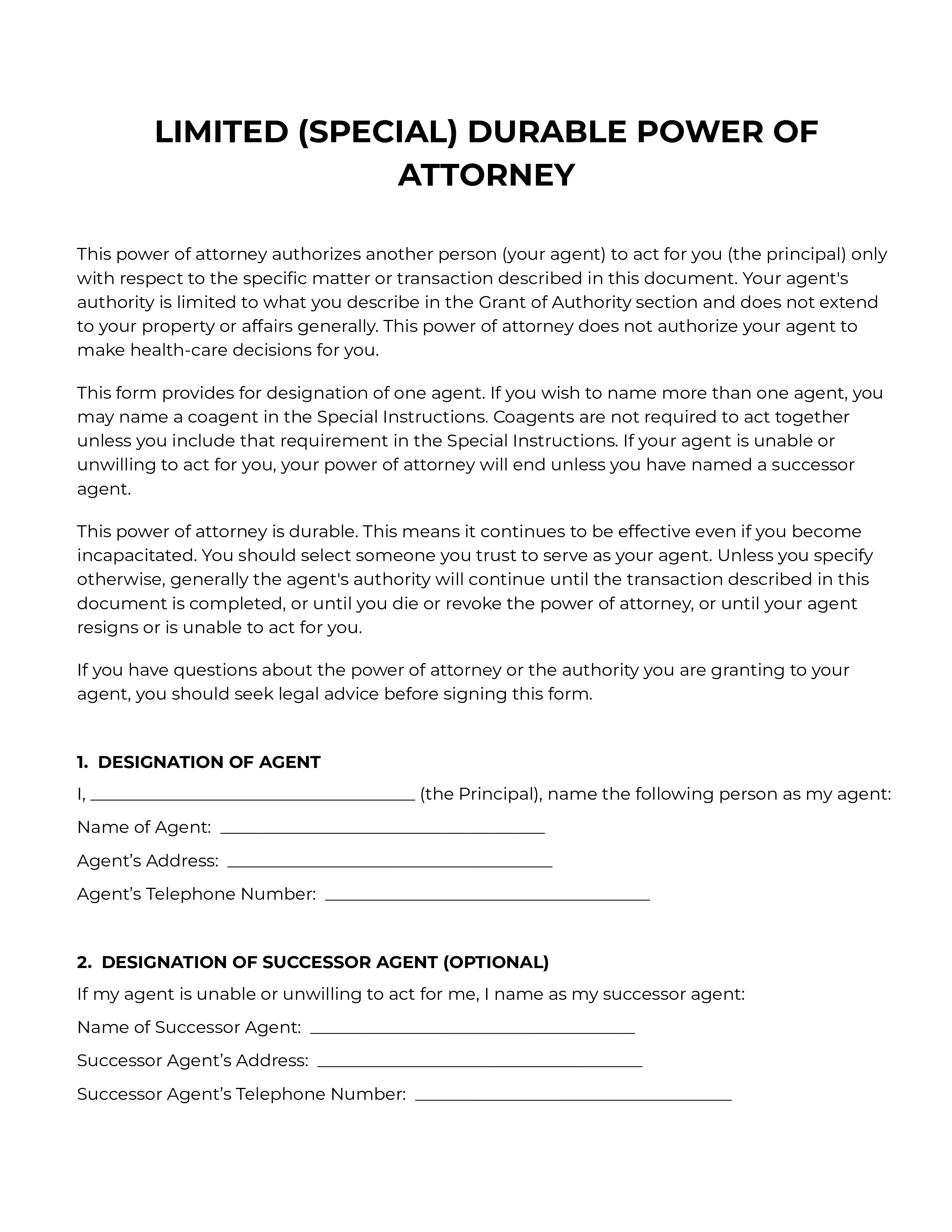
A Limited (Special) Durable Power of Attorney is a document in which one person, called the Principal, gives another person, called the Agent, authority to act on their behalf for a single defined matter or transaction. Unlike a general power of attorney, it does not hand over control of the Principal's property or affairs as a whole. The Agent can only act within the specific task written into the Grant of Authority section, and nothing beyond it.
The "durable" part means the authority continues even if the Principal later becomes incapacitated — that is, unable to manage their own affairs. A power of attorney that is not durable would end at that point; a durable one carries on, which is what makes it useful for matters that may run past the point where the Principal can still act for themselves.
This kind of document is built around a narrow purpose. It authorises the Agent to take the steps reasonably needed to complete the named matter, such as signing documents and dealing with third parties, but only as to that matter. It does not authorise the Agent to make health-care decisions.
When People Use It
- A specific transaction needs to go ahead while the Principal is unavailable, travelling, or may not be able to act when the time comes, such as a property sale or closing.
- Someone wants help with a single financial or legal matter without granting authority over everything they own.
- A matter is expected to continue over a period during which the Principal's capacity might change, and the authority needs to survive that change.
- The Principal wants a trusted person to handle one defined task and nothing more.
Why People Use It
- It keeps the Agent's authority tightly contained to one matter, rather than giving broad control.
- It continues to operate through incapacity, so the named task can still be completed if the Principal can no longer act.
- It lets a specific transaction move forward without the Principal needing to be present for each step.
- It sets out the Agent's duties and the limits on their authority in writing, so both sides understand the scope.
What the Template Gives You
- A designation section for the Agent, with space for a successor agent if the first is unable or unwilling to act.
- A Grant of Limited Authority section where the single matter or transaction is described in the Principal's own words.
- A Special Instructions section that also captures co-agents, a second successor, changes to the Agent's default duties or compensation, and a marriage-dissolution carve-out where wanted.
- Standard protective provisions: a limitation on self-benefit, durability and effective-date language, revocation, reliance, severability, and governing law.
- Execution blocks for the Principal's signature, a notary acknowledgment, witness attestation, and the Agent's acknowledgment.
- An Important Information for the Agent section setting out the Agent's legal duties and what ends their authority.