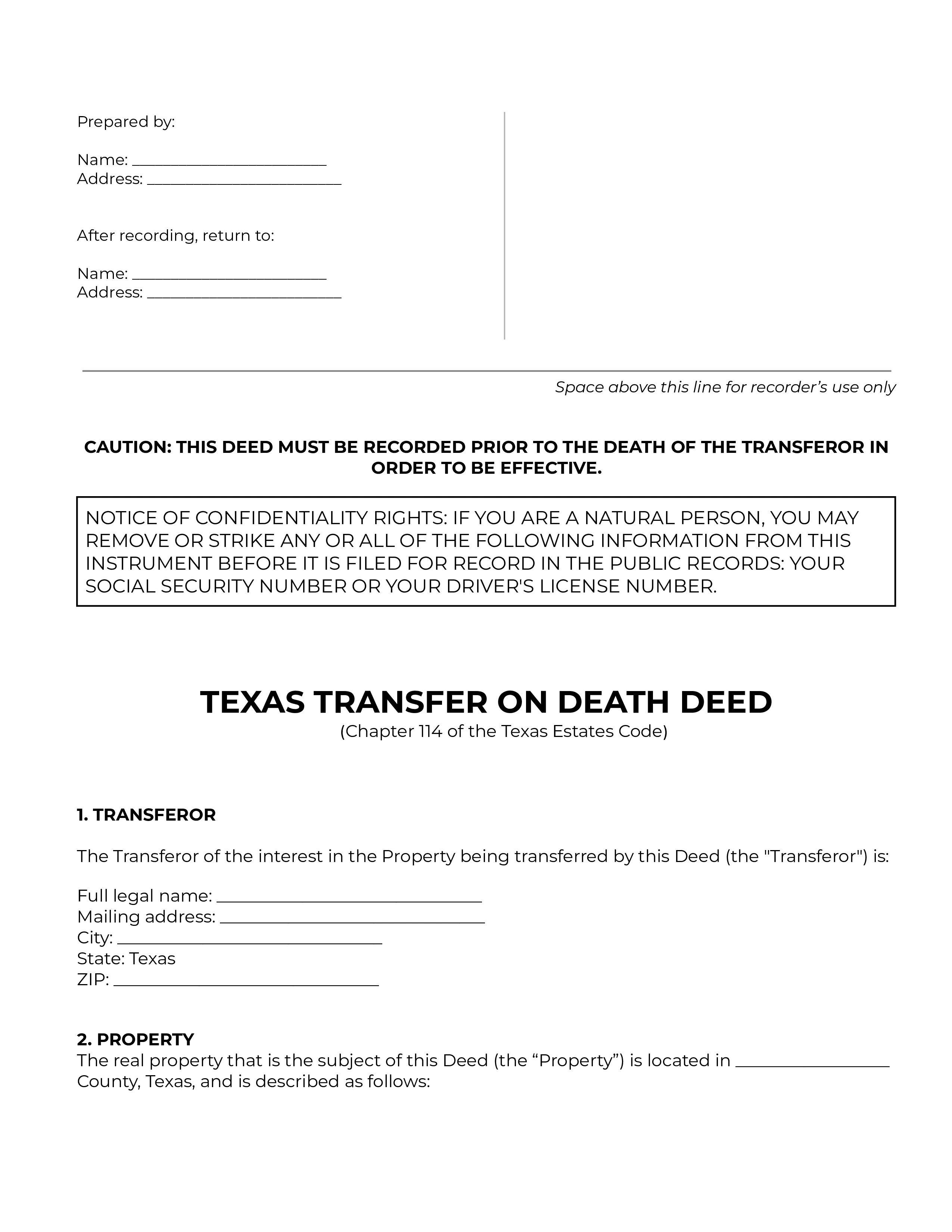
What is a Texas Transfer on Death Deed?
A Transfer on Death Deed (often shortened to TODD) is a document a property owner signs and records during their lifetime that names one or more beneficiaries to receive the property automatically at the owner's death. It is authorized by Chapter 114 of the Texas Estates Code. The property stays fully under the owner's control while they are alive — they can sell it, mortgage it, or change their mind — and nothing passes to the beneficiary until death. Because the transfer happens by operation of the recorded deed rather than through a will, the property generally does not go through probate for that asset. The deed takes effect only if it is recorded in the county where the property is located before the owner dies; an unrecorded one has no effect.
When People Use It?
- When a Texas homeowner wants their house or land to go to a specific person at death without that property going through probate.
- When someone is doing estate planning and wants a simple, revocable way to direct a single piece of real estate, alongside or instead of relying on a will for that asset.
- When a sole owner wants to keep complete control of the property during life, including the ability to sell it or revoke the deed at any time before death.
- When a person wants to name more than one beneficiary to share a property at death.
Why People Use It?
- It avoids probate for the property it covers, which can save the beneficiaries time and cost.
- It is revocable: the owner can change or cancel it at any time before death, so it does not lock anything in.
- It keeps the owner in full control during life — the beneficiary has no rights, no say, and does not even need to be told the deed exists.
- It is a relatively simple, low-cost alternative to more involved arrangements like a living trust for directing a single property.
What the Template Gives You?
- A complete Texas TODD structured around Chapter 114, with sections for the transferor, the property, the beneficiary or beneficiaries, and the transfer itself.
- A property section prompting the legal description as it appears on the current deed, which is the part that identifies the parcel for recording.
- Language that handles one beneficiary or several, including how multiple beneficiaries share the property under Texas's default rule.
- A notary acknowledgment block and a prominent recording caution, so the steps that make the deed effective are built into the document.
- A confidentiality-rights notice, which Texas requires on instruments filed in the public records.