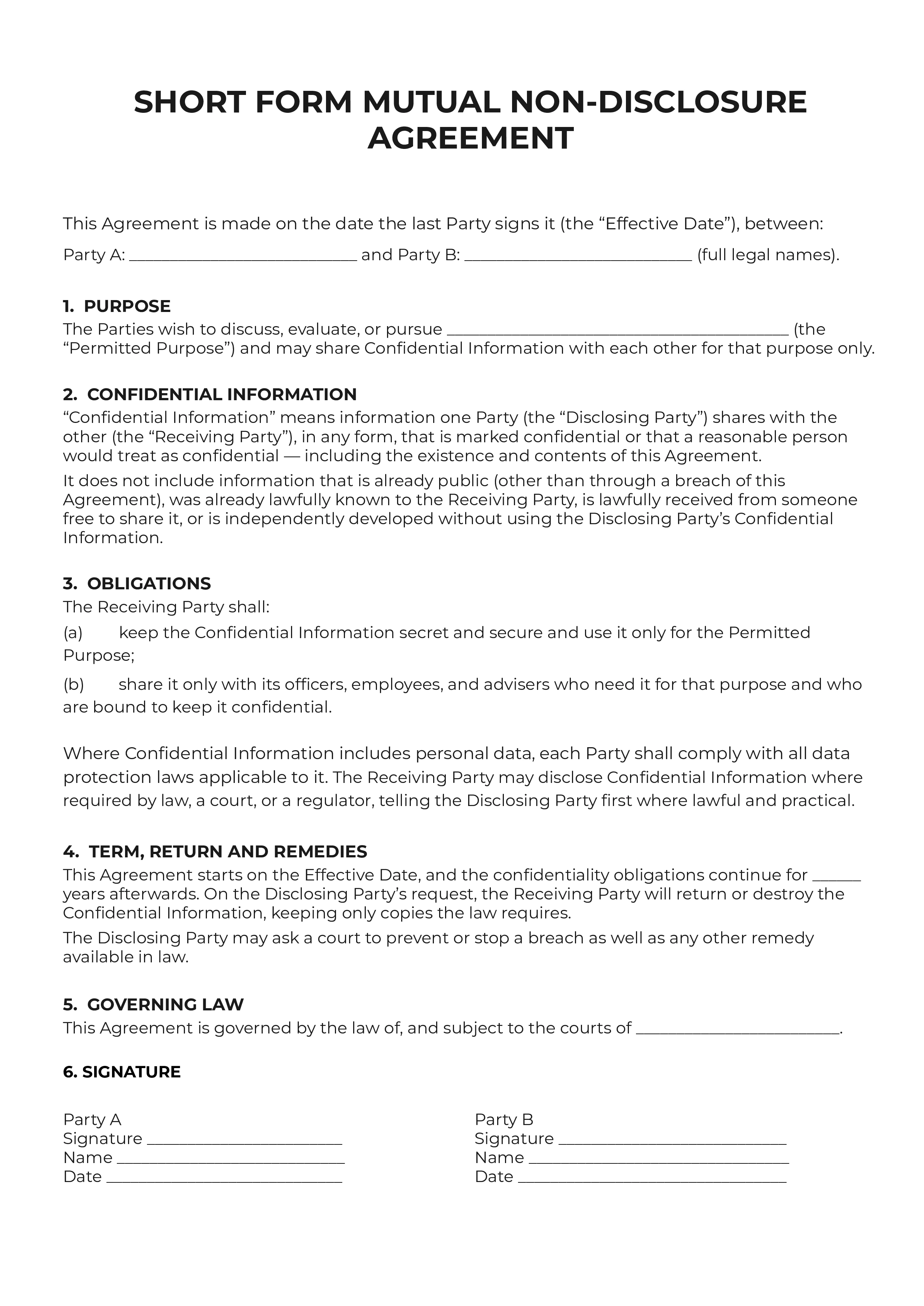
A short form mutual non-disclosure agreement (NDA) is a brief contract in which two parties agree to keep confidential the information they share with each other. "Mutual" means the duties run both ways: each party can be the Disclosing Party (the one sharing information) and the Receiving Party (the one receiving it). "Short form" means it covers the core terms in a compact, readable way, without the extended provisions found in longer agreements. Zendocs provides a ready-to-fill version for use in the UK.
Three main reasons: First, it protects confidential information - including the existence and contents of the agreement itself - during early, preliminary talks. Second, it applies the same obligations to both sides, which can make negotiation faster and more even-handed. And third, it sets a clear time limit and a process for returning or destroying information once the discussions end.
It's pretty straightforward with Zendocs:
The template covers the purpose of the disclosure, a definition of Confidential Information and what falls outside it (information already public, already lawfully known to the receiving party, lawfully received from someone free to share it, or independently developed), and the receiving party's obligations: keep the information secret and secure, use it only for the Permitted Purpose, and share it only with officers, employees and advisers who need it and are bound to keep it confidential. It also deals with personal data, disclosure required by law, how long the agreement lasts, return or destruction of the information, court remedies, governing law and signatures.
Mostly businesses and individuals about to share sensitive information with each other: two companies exploring a partnership, investment or transaction, or a business sharing plans, pricing or technical details with a supplier, contractor or adviser. It suits situations where both sides expect to disclose confidential material and a lighter-touch agreement is enough.
If only one party will be sharing confidential information, a one-way (unilateral) NDA is the better fit. If your deal needs longer or more specialised terms, such as an investment or technology and IP arrangement, a dedicated NDA for that situation may suit you better. A short form is designed for straightforward, early-stage discussions.
The agreement is made on the date the last party signs it (the Effective Date). The confidentiality obligations then continue for the number of years you entered, counted from that date.
Once you've filled everything out in Zendocs, go to the signature step. You can sign straight away with our e-signature tool, or leave the block blank so the parties can sign later. Remember that the agreement only takes effect once the last party has signed.