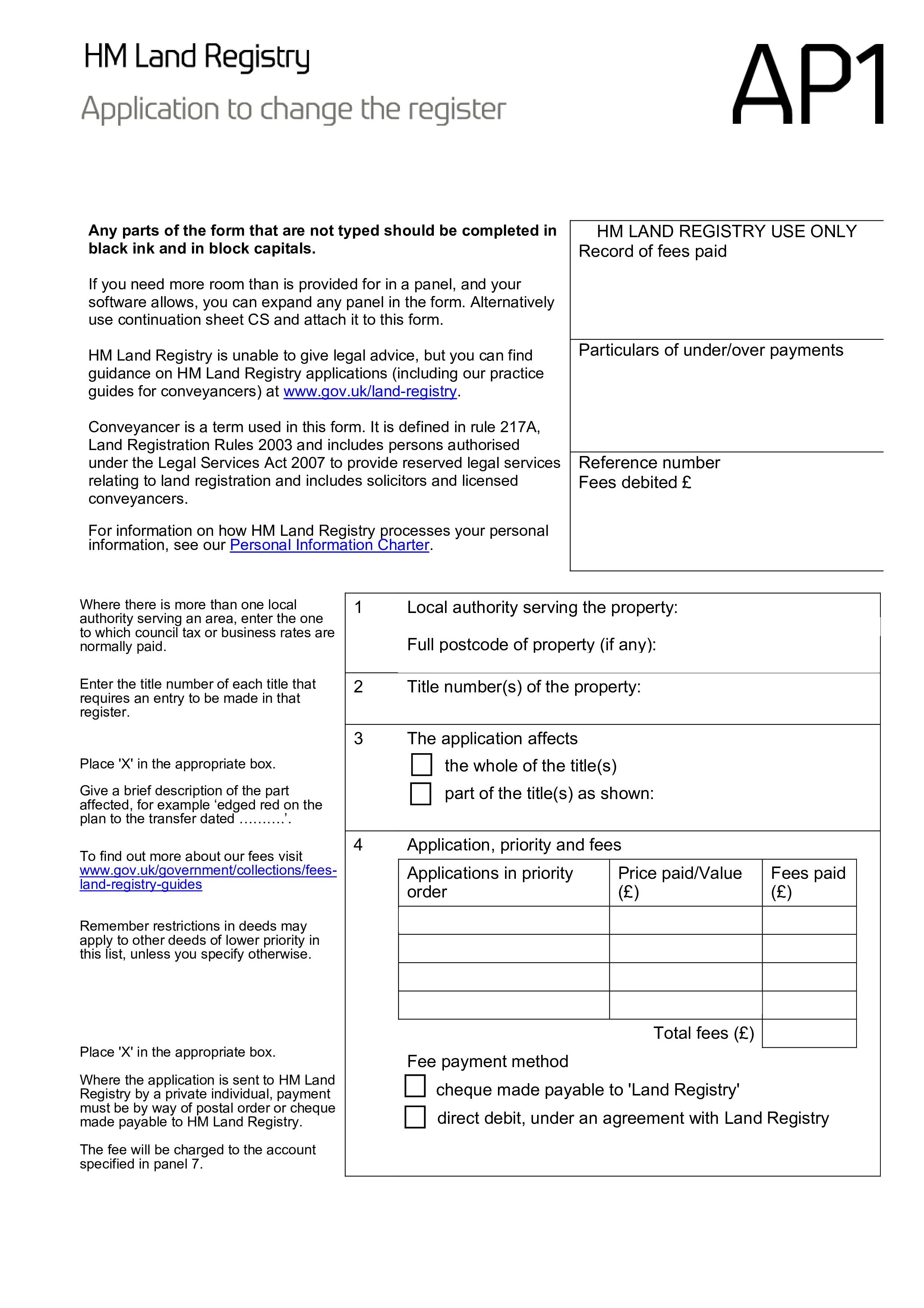
Form AP1, Application to Change the Register, is HM Land Registry's general-purpose cover form used to request any change to a registered property's title in England and Wales. It's the most frequently submitted HM Land Registry form because nearly every change to a title - a sale, a gift, a name change, a new mortgage, a mortgage discharge, or a restriction - goes through AP1. The form itself doesn't make the change; it accompanies the actual deed (such as a TR1, TP1, or charge document) and tells the registry exactly what to do with it.
Common uses include: registering a transfer of the whole or part of a title (lodged with a TR1 or TP1 deed); registering the grant of a new mortgage (lodged with a charge document); registering the discharge of a mortgage once it's repaid; changing the registered proprietor's name (following marriage, divorce, or deed poll); adding or removing a restriction (such as one requiring two signatures for a sale); correcting an error on the register; and registering a death of a joint proprietor (often alongside a death certificate).
AP1 rarely stands alone. It's submitted with the deed or document that causes the change (TR1 for a whole transfer, TP1 for a partial transfer, a charge document for a new mortgage, a deed of discharge (DS1 or similar) for a repaid mortgage), any required identity evidence (Form ID1 for unrepresented individuals), evidence of Stamp Duty Land Tax compliance (SDLT5 certificate or confirmation), and the applicable HM Land Registry fee, which is scaled to the property value and type of application.
Most applications are submitted electronically through HM Land Registry's Portal or Business Gateway by conveyancers, which is faster and often qualifies for a reduced fee compared to paper submissions. Paper AP1 by post is still accepted. Processing times vary significantly depending on application complexity and current HM Land Registry workloads - simple, well-prepared applications (like a straightforward transfer) can complete in weeks, while complex applications with defects or missing evidence can take many months. Check HM Land Registry's published processing time estimates before submitting.
Choose your legal form
Browse the library or search to find the exact template you need
Answer simple questions
The guided editor turns your answers into a finished legal form
Sign your document
E-sign, then download, print, or share your legal document instantly
1.Choose your legal form
Browse the library or search to find the exact template you need
2.Answer simple questions
The guided editor turns your answers into a finished legal form
3.Sign your document
E-sign, then download, print, or share your legal document instantly