How to Fill Out Form C5 (Rev. December 2021)
Form C5 Instructions, Line by Line
Reviewed by Zendocs Team. Updated 20 November 2026. 20 min read. Based on Form C5 (2006), printed HMRC 12/21, and the HMRC notes in booklet C3(2006) (2021).
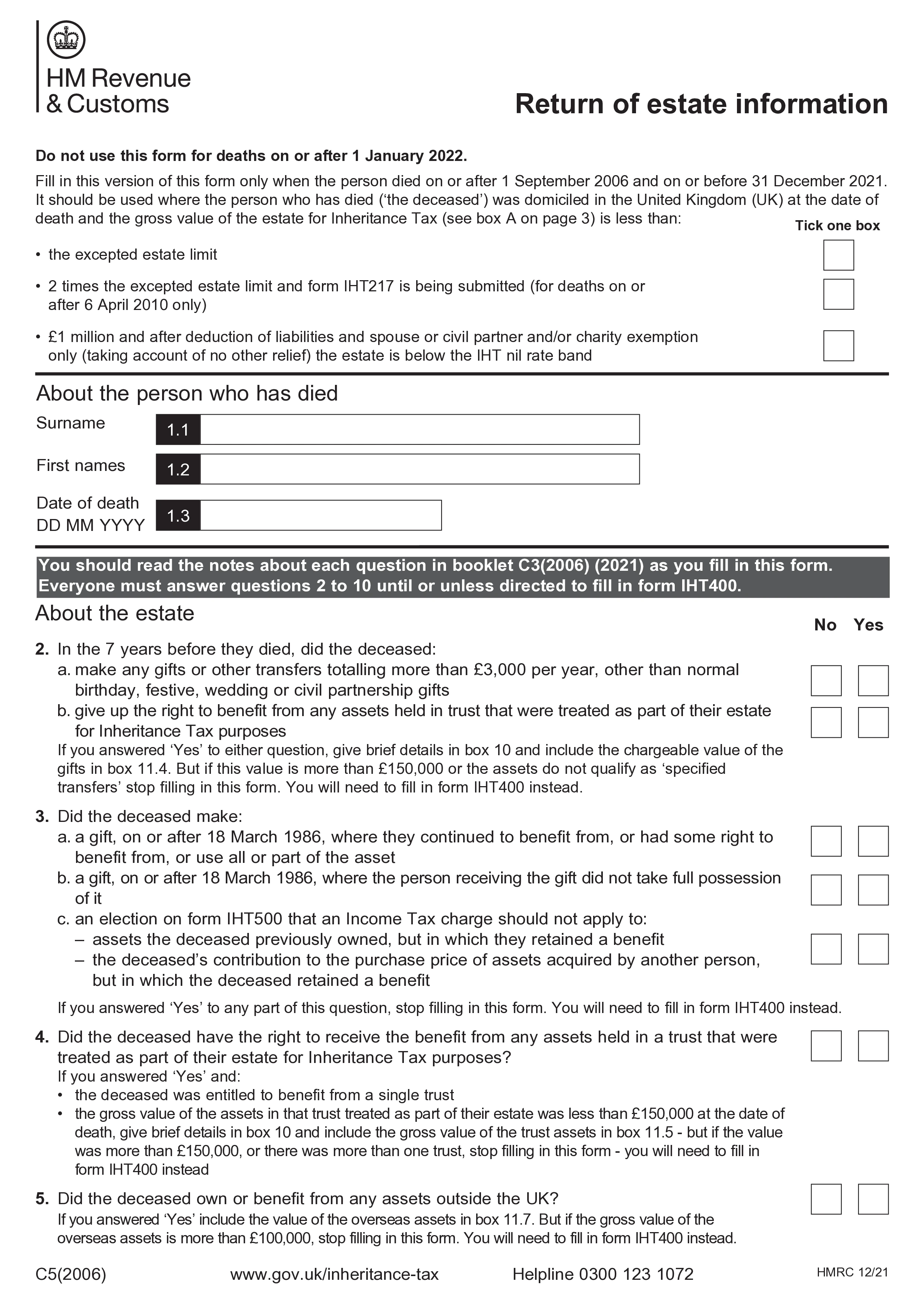
Form C5
How to Fill It Out
Line-by-line guide with a completed example
Quick answer
- Tick one of the three estate limit boxes, then enter the surname, first names and date of death (1.1 to 1.3).
- Answer questions 2 to 7. A Yes to most of them means you stop and fill in form IHT400 instead. Answer question 8 only if question 7 is Yes.
- Answer question 9 only if you deduct a spouse, civil partner or charity exemption.
- Give details of gifts or a trust in box 10, then fill in the summary of the estate in boxes 11.1 to 11.7, A, B and C.
- Enter the exemption in box D, work out box E, then sign and date the declaration.
- Send the form with form C1(2021) to the Sheriff Clerk or Commissary Office, not to HMRC.
What you need before you start
Form C5 is a summary, so most of the work happens before you open it: the answers come from the Confirmation Inventory and from the deceased's papers. Have these ready.
- Form C1(2021), the Confirmation Inventory. Box 11 of C1 gives you box 11.1 of the C5, and the totals from the C5 go back into boxes 21, 22 and 23 on page 5 of the C1.
- The HMRC notes. Keep booklet C3(2006) (2021) open as you go. The form itself tells you to read the notes for each question.
- Basic details: the surname, first names and exact date of death of the person who died.
- Records of gifts. Gifts and other transfers in the 7 years before death, with dates, recipients and values, and any gift where the person kept using or benefiting from the asset.
- Papers on trusts, overseas assets, life insurance and pensions. Questions 4 to 8 ask about each of these.
- Values and debts. Jointly held assets, nominated assets, pension lump sums, and the debts and funeral costs that count as liabilities.
- Form IHT217, only if it applies. You attach it when you claim a transfer of unused nil rate band from a spouse or civil partner who died first.
Before you start, check two things. The person must have died on or after 1 September 2006 and on or before 31 December 2021, and must have been domiciled in the United Kingdom at the date of death. The form says plainly that it is not for deaths on or after 1 January 2022.
Form C5 fields at a glance
| Line | What to enter | Required |
|---|---|---|
| Tick box | One of the three estate limits | Required |
| 1.1 | Surname of the person who died | Required |
| 1.2 | First names | Required |
| 1.3 | Date of death, as DD MM YYYY | Required |
| 2a, 2b | Gifts over £3,000 a year, or a trust benefit given up, in the 7 years before death | Required, Yes or No |
| 3a, 3b, 3c | Gifts with reservation, gifts not fully taken, IHT500 election | Required, Yes or No |
| 4 | Right to benefit from assets held in trust | Required, Yes or No |
| 5 | Assets outside the UK | Required, Yes or No |
| 6 | Life insurance premiums paid for someone else, or an annuity bought | Required, Yes or No |
| 7 | Any pension other than the State Pension | Required, Yes or No |
| 8 | Alternatively secured pension, dependant's pension, pension changes in the last 2 years | Only if question 7 is Yes |
| 9 | Legitim fund claimed or discharged, and the value of undischarged legal rights | Only if you deduct a spouse, civil partner or charity exemption |
| 10 | Details of gifts, the trust, your legitim calculation, anything relevant | Needed if question 2 or 4 is Yes |
| 11.1 to 11.7 | Assets that make up the estate | Required |
| A, B, C | Gross estate, total liabilities, net estate | Required |
| 12, D, E | Exemptions, and the net qualifying value of the estate | Box D required, write 0 if none |
| Declaration | Signature and date | Required |
Step by step
Work through the form in page order. Questions 2 to 9 are checkpoints: each one either lets you carry on or sends you to form IHT400, so answer them before you spend time on the figures.
Open the form and check the edition
Open Form C5 in the Zendocs editor. The fields you can type into are highlighted, and the three pages are listed as thumbnails on the left. At the bottom right of page 1 the form prints its edition, which should read HMRC 12/21. The HMRC notes explain that the edition date on the form decides which version of the notes you follow.

Tick one estate limit box
At the top of page 1, tick the one box that describes the estate. The estate must be worth less than the limit you choose, and the value that counts is the gross estate in box A on page 3. You can come back to this step once you know that figure.
- The excepted estate limit. The normal choice for a small estate with no spouse or charity exemption. The limit is the Inheritance Tax nil rate band: £325,000 for deaths from 6 April 2009, and £285,000, £300,000 or £312,000 for deaths in the tax years 2006-07, 2007-08 and 2008-09.
- 2 times the excepted estate limit, with form IHT217. For deaths on or after 6 April 2010 where you claim unused nil rate band from a spouse or civil partner who died first. You attach form IHT217.
- £1 million, with a spouse, civil partner or charity exemption. The gross estate is below £1 million and, once liabilities and that exemption are taken off, the estate is below the nil rate band.
Why it matters: the box you tick is the test HMRC applies to the rest of the form. If box E later turns out to be above the limit for your box, you cannot stay on form C5.

Questions 1.1 to 1.3: about the person who has died
Enter the surname in 1.1, the first names in 1.2 and the date of death in 1.3. The date has three separate boxes, in the order day, month, year, so 14 March 2021 is 14, 03, 2021. The form asks you to repeat this basic information in case the C5 becomes detached from the Inventory, so make it match form C1(2021) exactly.

Questions 2 and 3: gifts
Questions 2a and 2b look back 7 years from the date of death. Answer 2a Yes only if gifts or transfers totalled more than £3,000 in a year, apart from normal birthday, festive, wedding or civil partnership gifts. You can still answer No if the gifts each stayed within the exemptions in the notes, for example gifts of no more than £250 to any one person in a tax year, or gifts made more than 7 years before death. Answer 2b Yes if the person gave up a right to benefit from assets held in trust.
A Yes to 2a or 2b does not end the form by itself. You give brief details in box 10 and put the chargeable value of the gifts in box 11.4. You stop and use form IHT400 only if that value is more than £150,000 or the assets are not 'specified transfers'.
Question 3 is stricter. Answer Yes to 3a if the person gave something away but kept some benefit from it, for example by carrying on living in a house they had given to their children. Answer Yes to 3b if the person who received the gift did not take full possession. Answer Yes to 3c if the person made an IHT500 election about the Income Tax charge on pre-owned assets. A Yes to any part of question 3 means you stop and fill in form IHT400.

Questions 4 and 5: trusts and overseas assets
Answer question 4 Yes if the person had a right to benefit from assets held in trust that count as part of their estate for Inheritance Tax, for example the right to the income or to live in a property. If there was a single trust and the trust assets in the estate were worth less than £150,000, give brief details in box 10 and put the gross value in box 11.5. If there was more than one trust, or the value was more than £150,000, stop and use form IHT400.
Answer question 5 Yes if the person owned or benefited from assets outside the UK. Put the value in pounds sterling in box 11.7. Add the person's own foreign assets, their share of jointly owned foreign assets and any foreign assets held in trust. If the total is more than £100,000, stop and use form IHT400. The Isle of Man and the Channel Islands are not part of the UK, so assets there count as overseas.

Questions 6 to 8: insurance and pensions
Question 6 asks about life insurance premiums paid for someone else's benefit, or premiums on a policy that did not pay out to the estate, and about any annuity the person bought. Ignore policies paid out to a surviving spouse or civil partner. Yes means you stop and use form IHT400. The notes list cases where you can still answer No, such as a policy held in trust for more than 7 years with premiums covered by the exemption for regular gifts out of income.
Question 7 asks whether the person had any pension other than the State Pension. No means you skip question 8 and go to question 9. Yes means you answer the three parts of question 8: an alternatively secured pension fund as the original scheme member, a dependant's pension from an alternatively secured or unsecured fund, and any change or disposal of pension benefits in the 2 years before death. A Yes to any part means you stop and use form IHT400.
You can answer No to all three parts of question 8 if the person was born on or after 22 June 1935, never received a dependant's pension and made no changes to their pension in the last 2 years, other than pensions paid to a spouse or civil partner.

Question 9: the legitim fund
Only answer question 9 if you are deducting a spouse, civil partner or charity exemption. It is a Scottish question: legitim is a legal right that children can claim against the estate. Tick N/A, No or Yes to say whether the legitim fund has been claimed or discharged in full after the death.
Where legal rights have not yet been claimed or renounced, work out the exemption as if they will be claimed in full. Enter that figure in the box for the value of undischarged legal rights, and use the same adjusted figure when you work out the exemption in box D. If the legitim fund plus the rest of the chargeable estate is above the excepted estate limit, stop and use form IHT400.

Question 10: details
Use box 10 to give details of the gifts (what was given, to whom and the value of each), details of the trust, your calculation of legal rights for question 9, and anything else you think is relevant. If the box is too small, the notes say you can attach a separate sheet. Leave it empty only if questions 2 and 4 are No and you have nothing to add.

Question 11: summary of the estate
List every asset that makes up the estate for Inheritance Tax, without taking off any exemptions or reliefs such as business or agricultural relief. If you cannot find a value, the form allows your best estimate.
- 11.1: Assets confirmed to, copied from box 11 of form C1(2021).
- 11.2: Pension payments not included for Confirmation.
- 11.3: The deceased's share of jointly held UK assets that pass automatically to the survivors.
- 11.4: Gifts and lifetime transfers, from question 2, after the allowed exemptions.
- 11.5: Assets held in trust for the deceased's benefit, from question 4.
- 11.6: Nominated assets not included for Confirmation.
- 11.7: Assets outside the UK, from question 5.
Then work out three totals. Box A is boxes 11.1 to 11.7 added together. Box B is the total liabilities, which includes debts on joint property and foreign debts as well as the debts you deducted in form C1(2021). Box C is A minus B. For example, with 11.1 at £400,000 and 11.3 at £50,000, box A is £450,000. With £20,000 of liabilities in box B, box C is £430,000.

Question 12: exemptions, and boxes D and E
Box D is for exemptions on assets that pass to the deceased's husband, wife or civil partner, or to a qualifying charity or for national purposes. Do not deduct agricultural or business relief here. If nothing passes to a spouse, civil partner or charity, write 0 in box D. If something does, describe it in box 12, for example residue of the estate or a legacy of a stated amount, and name any charity in full with its country of establishment and reference if you have one. Where legitim applies, base the exemption on the basis that undischarged legal rights will be claimed in full.
Box E is C minus D. It is the net qualifying value, and it is the figure that must stay below the limit for the box you ticked at the start. Continuing the example, if all £430,000 passes to the surviving spouse, D is £430,000 and E is £0. If the figure in box E is above the excepted estate limit, you must fill in form IHT400, unless you are claiming a transfer of unused nil rate band, in which case you attach form IHT217.

Sign and date the declaration
Read the declaration at the bottom of page 3. By signing you state that the information is correct and complete to the best of your knowledge and belief. Only one signature is needed on form C5, but the notes say all the executors should have checked the content and the executor who signs should have the agreement of all of them. In the editor, select Sign in the toolbar to add your signature. The options are Draw, Image and Type. Then enter the date next to the signature.


When every answer is in, finish in the editor and keep a copy. HMRC recommends keeping a copy of the signed form, because you need it if the value of the estate changes after Confirmation.
Form C5 examples by situation

Simple estate with no gifts, trusts or overseas assets
- Estate limit: tick the excepted estate limit box
- Questions 2 to 5: No on every line
- Questions 6 and 7: No, so question 8 is skipped
- Box 11.1 carries the estate figure, and with box A below the limit the notes say box 12 can be skipped
- Every checkpoint is a No, so nothing sends you to form IHT400 and only the summary figures need to be filled in.

Gifts of more than £3,000 in one year
- Question 2a: Yes
- Question 2b and all of question 3: No
- Box 10: list each gift, who received it and its value
- Box 11.4: the chargeable value of the gifts after the allowed exemptions
- A Yes at 2a does not stop the form unless the gifts are worth more than £150,000 or are not specified transfers, but HMRC needs the details and the value.

All assets pass to a surviving spouse
- Estate limit: tick the £1 million box
- 11.1 £400,000 and 11.3 £50,000, so box A is £450,000
- Box B £20,000, so box C is £430,000
- Box 12 describes the spouse exemption, box D is £430,000 and box E is £0
- The spouse exemption is the deduction allowed at box D, so box E falls below the limit even though box A is above the excepted estate limit.
Completed Form C5 example

Sample for illustration only. Not a real form. Do not submit.
If a field does not apply
Some boxes are conditional, and the notes say how to treat each one.
- Question 8: skip it if the answer to question 7 is No.
- Question 9: answer it only if you are deducting a spouse, civil partner or charity exemption.
- Box 10: needed if question 2 or 4 is Yes. Otherwise add anything relevant, or leave it empty.
- Box D: if no asset passes to a spouse, civil partner or qualifying charity, write 0.
- Box 12: the notes say you need not fill in this section if the value in box A is below the excepted estate limit, because no tax is due.
Common Form C5 mistakes and how to avoid them
Most problems with this form come from using the wrong edition, missing a Yes that should have sent you to form IHT400, and leaving out assets that were not in the Inventory. Each item below says how to avoid the mistake.
Using this form for a death on or after 1 January 2022
The form states that it is not for deaths on or after 1 January 2022. People reuse an old copy because the layout looks the same. The limits changed from that date, so the result may be wrong. Check the date of death first and use the current form from GOV.UK for later deaths.
Answering No to question 3a when the person kept benefiting from a gift
A parent who gave a house to a child but carried on living in it has made a gift with reservation. Answering No can lead to tax and a penalty later. If you are unsure, the notes recommend answering Yes, and then you complete form IHT400 instead.
Leaving out assets that are not in the Inventory
Pension lump sums, jointly held assets passing by survivorship, nominated assets and overseas assets are not all in form C1(2021) for Confirmation. They still count for Inheritance Tax, so they go in boxes 11.2, 11.3, 11.6 and 11.7. Missing them understates box A and can put the estate over a limit.
Deducting business or agricultural relief at box D
Box D is only for spouse, civil partner and qualifying charity exemptions. Taking off other reliefs makes box E too low, so an estate looks like an excepted estate when it is not. Leave those reliefs out of this form.
Deducting the regular gifts out of income exemption when gifts are above £3,000 a year
For deaths on or after 1 March 2011, if gifts out of income were more than £3,000 a year you must not deduct that exemption for the years concerned. Add the full value of the gifts to box 11.4. The notes give an example where doing otherwise would wrongly keep an estate on form C5.
Sending the form to HMRC
An excepted estate return does not go to HMRC. It goes with form C1(2021) to the Sheriff Clerk or the Commissary Office, as the notes explain. The notes say not to send these forms to HMRC Trusts and Estates.
Signing without the other executors checking
One signature is enough, but financial penalties can apply if the information is incorrect, incomplete or false. The signing executor should have the agreement of all executors that the content is right.
Correcting Form C5 after Confirmation
You do not have to tell HMRC about every change. What you must do depends on whether the new figures take box E above the Inheritance Tax nil rate band.
- Box E is still within the limit. Make a note of the change and keep it. You do not need to tell HMRC. If you found more assets that need Confirmation, fill in form C4(S) (2021) and send it directly to the Sheriff Clerk.
- Box E is now above the nil rate band. Fill in the form C4(S) (2021) Corrective Inventory and Account, which must be signed by all the executors, and send it to HMRC Trusts and Estates with copies of the original C1(2021) and C5. You also need to pay any tax that is due.
The notes explain that the tax is worked out by deducting the nil rate band from the revised value and taking 40% of the result, and that interest runs from 6 months after the end of the month in which the person died. If you change the exemption after a deed of variation, treat that as a change to the exemptions and use the corrective account where tax is due.
Final checklist
Go through this list before you sign.
- The date of death is between 1 September 2006 and 31 December 2021, and the person was UK domiciled.
- Exactly one estate limit box is ticked and it fits box A and box E.
- Names and date of death match form C1(2021).
- Questions 2 to 7 are answered, and question 8 and 9 only where they apply.
- No Yes answer is left that tells you to stop and fill in form IHT400.
- Box 10 explains any gifts or trust, and the values in 11.4 and 11.5 match it.
- Boxes A, B, C, D and E add up, and A, C and E are carried to boxes 21, 22 and 23 on page 5 of form C1(2021).
- The declaration is signed and dated, and form IHT217 is attached if you claim unused nil rate band.
- You have kept a copy of the signed form.
Where to send it
Send form C5 together with form C1(2021) to the Sheriff Clerk. Confirmation is granted by the Sheriff Court of the district where the person was domiciled at the date of death, or by the Commissary Office, 27 Chambers Street, Edinburgh, EH1 1LB, for example where the person was domiciled in the Edinburgh Sheriff Court District. Do not send forms for an excepted estate to HMRC Trusts and Estates. If the estate is not an excepted estate you send form C1(2021) and form IHT400 to HMRC instead.
You do not need to send the other papers you used, only the form and any continuation sheets for boxes 10 and 12. Keep the papers safe in case HMRC asks for them. If HMRC has questions it will contact you within 60 days of the date of Confirmation. The issue of Confirmation does not mean there is no Inheritance Tax due on the estate.
Official instructions
These are the pages and documents the guide is based on.
- About Form C5, Return of estate information (GOV.UK)
- Form C5 (2006), HMRC 12/21 (PDF)
- Notes for completing forms C1 and C5, booklet C3(2006)
- Form C4(S) (2021) Corrective Inventory and Account (PDF)
- Inheritance Tax forms (GOV.UK collection)
- Inheritance Tax helpline: 0300 123 1072, or +44 300 123 1072 from outside the UK.