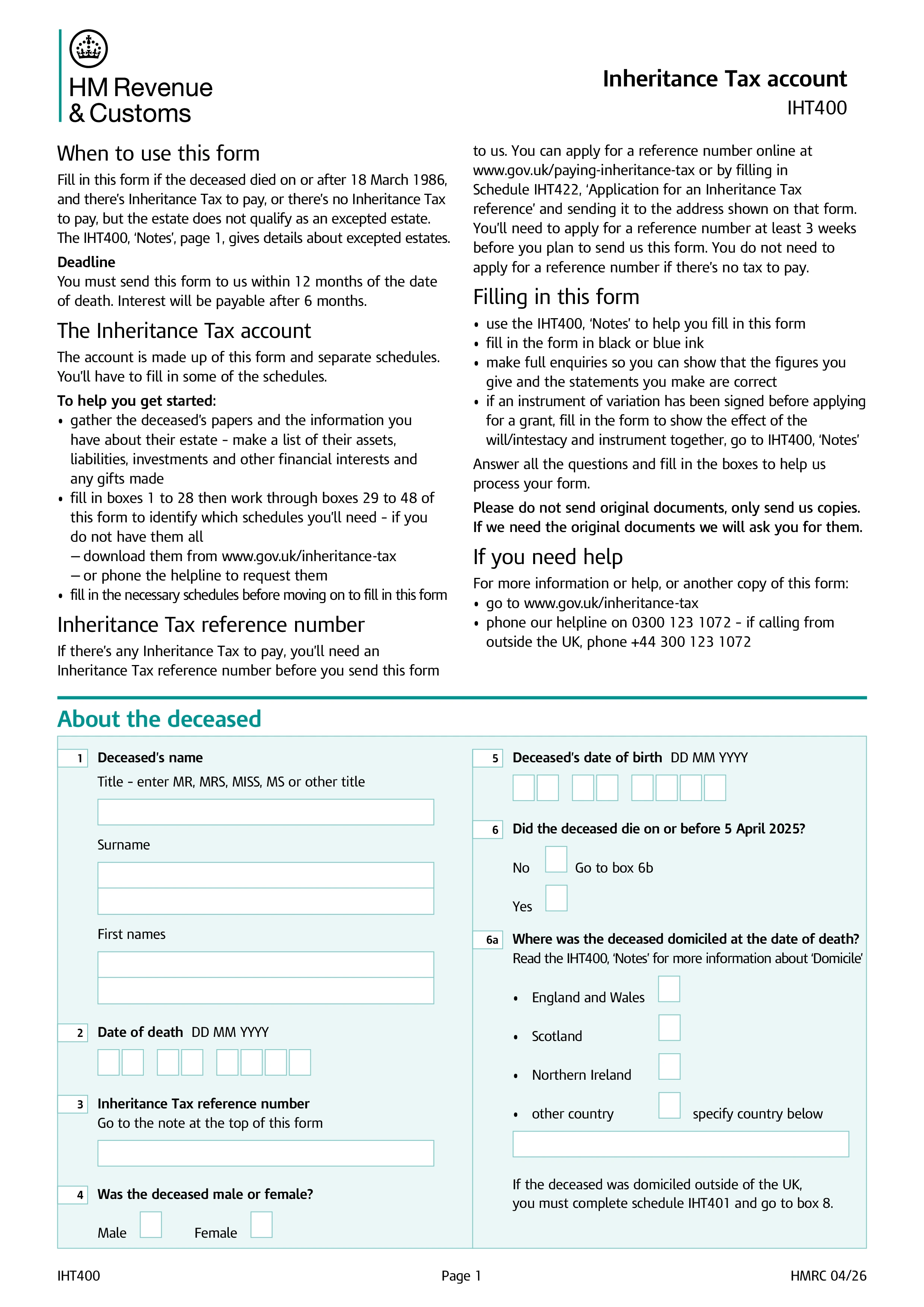
Form IHT400, Inheritance Tax account, is the main return HMRC uses to assess Inheritance Tax on a deceased person's estate. It's required for "non-excepted" estates - broadly, those where Inheritance Tax may be due, where reliefs and exemptions need detailed reporting, or where the estate doesn't meet the simplified conditions for excepted estate reporting. IHT400 gathers a complete picture of the deceased's assets, debts, lifetime gifts, trust interests, and the reliefs and exemptions being claimed, so HMRC can calculate the tax owed.
Since January 2022, most low-value and exempt estates no longer need to complete a full IHT400 and instead report via the simplified probate process using estate information provided directly to the probate registry. IHT400 is still required when the estate's value exceeds the available nil-rate band (currently £325,000, potentially more with the transferable nil-rate band from a predeceased spouse and the residence nil-rate band); the estate includes foreign assets worth more than £100,000; the deceased made significant lifetime gifts within seven years of death; the estate includes trust interests; or Inheritance Tax reliefs like Business Relief or Agricultural Relief are being claimed.
IHT400 works with a family of supporting schedules for specific asset types and situations: IHT401 (domicile outside the UK), IHT402 (claiming the transferable nil-rate band), IHT403 (gifts and other transfers of value), IHT404 (jointly owned assets), IHT405 (houses, land, buildings), IHT406 (bank and building society accounts), IHT407 (household and personal goods), IHT409 (pensions), IHT410 (life assurance and annuities), IHT412 (unlisted stocks and shares), IHT418 (assets held in trust), and others. The executor completes only the schedules relevant to the estate's actual assets.
IHT400 must be sent to HMRC within 12 months of the date of death, though it's best practice to file well before that to avoid delays in the probate process - probate (or confirmation in Scotland) typically cannot be granted until HMRC has processed the IHT400. Any Inheritance Tax due is normally payable within 6 months of the end of the month of death, after which HMRC charges interest on the outstanding amount. Executors can pay in instalments for certain assets like land and some business interests. Submit online through HMRC's Inheritance Tax service or by post with the completed IHT400 and all relevant schedules.
Choose your legal form
Browse the library or search to find the exact template you need
Answer simple questions
The guided editor turns your answers into a finished legal form
Sign your document
E-sign, then download, print, or share your legal document instantly
1.Choose your legal form
Browse the library or search to find the exact template you need
2.Answer simple questions
The guided editor turns your answers into a finished legal form
3.Sign your document
E-sign, then download, print, or share your legal document instantly