How to Fill Out Form MN1 (2026)
Form MN1 Instructions, Line by Line
Reviewed by Zendocs Team. Updated 26 November 2026. 24 min read. Based on Form MN1 (version 03/2026) and the Home Office MN1 guidance.
Form MN1
How to Fill It Out
Line-by-line guide with a completed example
Quick answer
- Form MN1 registers a child under 18 as a British citizen. It is the form for people in the Channel Islands, the Isle of Man or a British overseas territory, and for people elsewhere who apply by post.
- Question 1.1 asks which section of the British Nationality Act 1981 you apply under. Decide this first, because it shapes the rest of the form.
- Section 5 needs a passport-size photograph of the child and two referees. Section 7 needs consent from the parents.
- The fee is £1,000 and there is no fee for biometric enrolment. The fee is not refunded if the application is refused.
- Sign question 8.9, keep a copy of everything and send the form with the fee and documents.
What you need before you start
Gather these before you open the form. Most delays come from a missing document or a referee who does not qualify, not from the form itself. The MN1 guidance lists the evidence for each route, so read it first.
- The route you apply under: the section of the British Nationality Act 1981 for question 1.1 (1(3), 1(3A), 3(1), 3(2), 3(5) or 4D are the routes this form covers).
- The child's documents: passport or travel document, and a full birth certificate showing the parents' names. For a child born abroad to a British parent you also need the parents' marriage certificate if they married, and the British parent's and grandparent's documents.
- Dates and addresses: the child's addresses for the last five years and every absence from the UK for Section 2, and the parent's addresses and absences for the three year period in Section 3 if it applies.
- Two referees: people who have known the child for at least three years and who meet the rules in Section 5. One should have dealt with the child in a professional role, such as a teacher or doctor.
- A passport-size photograph of the child: Section 5 has a space for it. Write the child's name and date of birth on the back before you attach it.
- Consent: from both parents, or a short letter that explains why one parent has not signed.
- The fee and the payment slip: the fee is £1,000 (see the fees table). Paper applications are paid by card or cheque with the payment slip.
Form MN1 fields at a glance
| Line | What to enter | Required |
|---|---|---|
| 1.1 | The section of the British Nationality Act 1981 the application is made under, for example SECTION 3(2) | Required |
| 1.2 to 1.3 | Earlier reference numbers and the date indefinite leave was granted, if the child has it | Only if it applies |
| 1.4 to 1.9 | The child's title, surname, other names, any other names used, the reason for a name change, and present nationality | Required, except 1.7 and 1.8 which apply only to name changes |
| 1.10 to 1.16 | National Insurance number (if any), date and place of birth, sex, marital status, address, telephone numbers and email | Required, except the National Insurance number |
| 1.17 to 1.20 | Details of an agent or solicitor, and the local authority for a citizenship ceremony if the child is over 17 years and 6 months | Only if it applies |
| 1.21 to 1.40 | The father's and mother's details and the parents' marriage or civil partnership | Required where the question applies |
| 1.41 to 1.48 | Details of the child's partner | Only if the child is married, in a civil partnership or living as if married |
| Section 2 | First arrival, addresses for the last five years, absences and the country the child will live in | Complete the parts your route asks for |
| Section 3 | The parent's residence in the three year period, the other parent's addresses and the grandparent's details | Only for routes that rely on a parent who is British by descent |
| Section 4 | Occupation or school, convictions, judgments, cautions and the good character questions | Child aged 10 or over |
| Section 5 | A passport-size photograph and the declarations and details of two referees | Required |
| Section 6 | Earlier fingerprints, medical conditions and, under 16, the adult who attends biometric enrolment | Required |
| Section 7 | Consent from the father, the mother or a guardian | Required |
| Section 8 | Full name, confirmations, signature and date | Required |
Step by step
The steps follow the form from the first page with fields to the signature. Each step names the question numbers, says what to enter and explains why the answer matters. All names, dates and addresses in the screenshots are made up.
Open the form in the editor
Open Form MN1 in the editor. The form has 30 pages. Page 1 is the cover, page 2 holds the instructions, and page 3 is the first page with fields: it starts Section 1. Use the page thumbnails on the left to move between pages.
The fields carry the same numbers as the printed form (1.1, 1.2 and so on), so you can follow this guide question by question. Dates are typed as eight digits, day then month then year, for example 12052014, and the boxes place each digit for you. The form asks for block capitals.
Read the MN1 guidance before you fill in anything. Question 8.2 asks you to confirm that you have read it, and the guidance explains every route and the evidence each one needs.

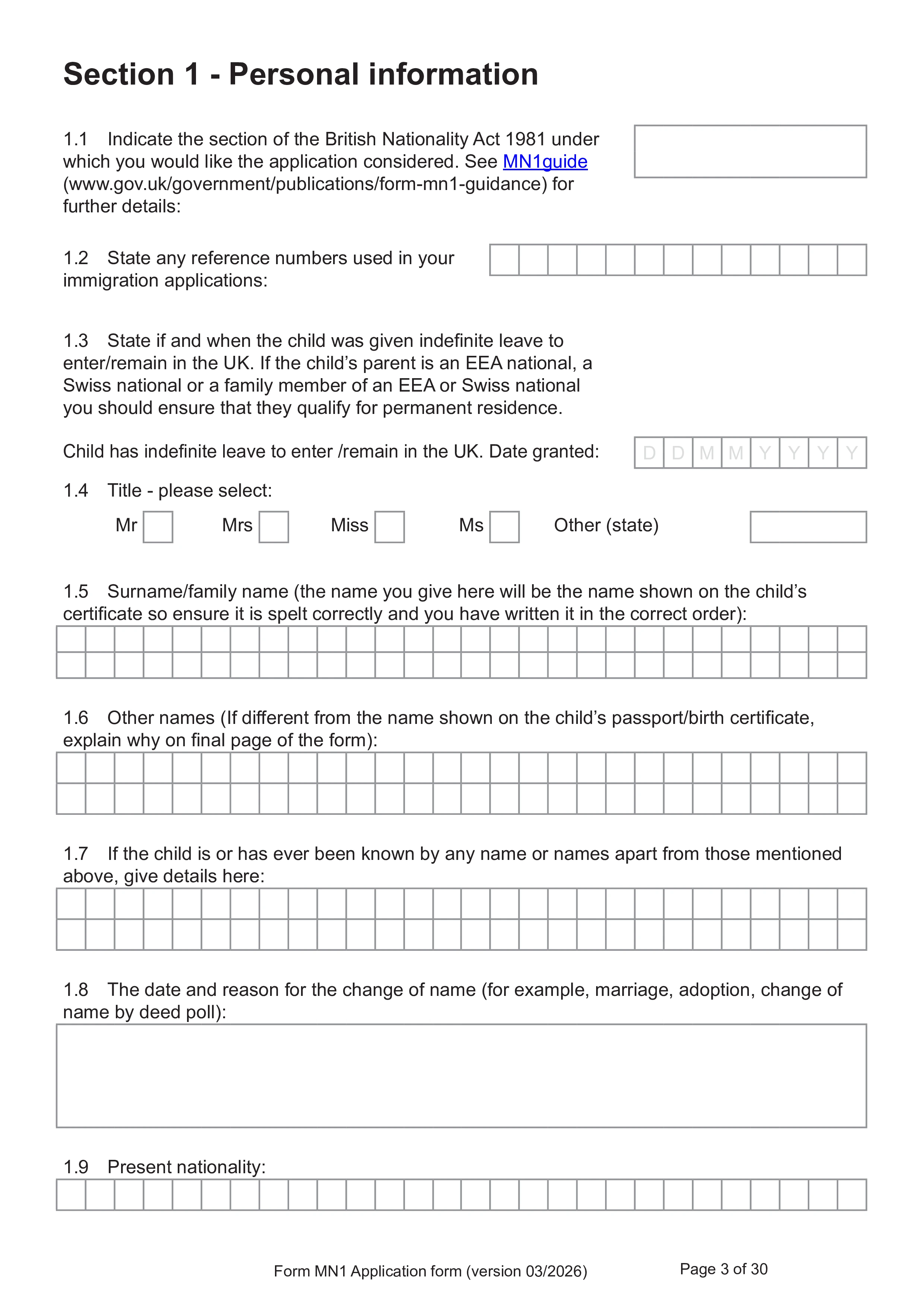
Questions 1.1 to 1.3: the section of the Act
1.1: enter the section of the British Nationality Act 1981 the application is made under, for example SECTION 3(2). The guidance covers sections 1(3), 1(3A), 3(1), 3(2), 3(5) and 4D.
This is the most important answer on the form. The section decides whether you rely on an entitlement or on the Home Secretary's discretion, which evidence the Home Office expects, and whether you must complete Sections 2 and 3. If you are not sure, read the matching part of the guidance or ask an adviser regulated by the Immigration Advice Authority.
1.2: enter any reference numbers from earlier immigration applications. Leave it empty if there are none.
1.3: if the child was given indefinite leave to enter or remain in the UK, enter the date it was granted. The form reminds you that if a parent is an EEA or Swiss national, or a family member of one, you should check that they qualify for permanent residence. Leave the date empty if it does not apply.

Questions 1.4 to 1.9: the child's names and nationality
1.4: tick one title, or write another one in the Other box.
1.5 and 1.6: enter the surname and the other names exactly as they should appear. The form says the name you give here will be the name shown on the child's certificate, so spell it correctly and put the names in the correct order.
1.7 and 1.8: use these only if the child is or has been known by another name. For a change of name, give the date and the reason, for example marriage, adoption or a deed poll.
1.9: enter the child's present nationality.
If the name differs from the one on the child's passport or birth certificate, the form asks you to explain why on the final page, the Further information page. A mismatch with no explanation is a common reason for follow-up questions.

Questions 1.10 to 1.16: birth, status and contact details
1.10: the National Insurance number, if the child has one. Leave it empty if not.
1.11 to 1.13: date of birth as eight digits, then the village, town or city and the country of birth.
1.14 and 1.15: tick the sex and one marital status only.
1.16: the present address, with the postcode split into two parts (the first four boxes, then the three after the dark box), the daytime and evening telephone numbers and the email address, which you type twice to confirm. The form says you must tell the Home Office in writing about any change of address while the application is being considered.
The Home Office uses these details to contact you, so use an email address you check, including the spam folder.


Questions 1.17 to 1.20: representative and ceremony details
1.17 to 1.19: if an agent or solicitor represents you, enter their name, address and telephone number. Leave these empty if nobody represents you.
1.20: complete this only for a child over 17 years and 6 months. If the child reaches 18 before the application is approved, they must take part in a citizenship ceremony, and the form asks for the local authority near where they live, or another area if you prefer.
A child who turns 18 during the application also owes an extra £130 ceremony fee at the decision stage (fees table). For a younger child, leave 1.20 empty.

Questions 1.21 to 1.38: the child's parents
Father, 1.21 to 1.29: name, date of birth, town and country of birth, address if different from the child's, telephone and email if different, and nationality. If he is a British citizen, the form asks how and when he became one (for example by birth, descent, registration or naturalisation). Then enter the date he became settled in the UK, and, only if he is or was in the armed forces, the date he joined and where he was serving when the child was born.
Mother, 1.30 to 1.38: the same questions. Question 1.30 also asks for her name before marriage, a wording the Home Office introduced in the March 2026 version of the form in place of "maiden name".
The parents' nationality, settlement and service details are what most routes rest on. For example, section 1(3) depends on a parent becoming British or settled, and sections 1(3A) and 4D depend on a parent serving in the UK armed forces. Answer for each parent as the question applies and leave the service questions empty if they do not.


Questions 1.39 to 1.48: parents' marriage and the child's partner
1.39 and 1.40: if the parents married or formed a civil partnership, give the date. Then say whether the mother was married when the child was born and, if so, whether the marriage was to the child's father or to someone else, with details.
Whether the parents were married matters for some routes, because the guidance explains how the father is established when the parents were not married.
1.41 to 1.48: complete these only if the child is married, in a civil partnership or living with someone as if married or in a civil partnership. They ask for that person's name and name at birth, date and place of birth, nationality and address, the date and place of the marriage or civil partnership, and any legal separation. For most children these stay empty.

Section 2: residence requirements
2.1: the date and place of the child's first arrival in the UK or a British overseas territory.
2.2: the child's addresses over the last five years (or since arrival if shorter), each with from and to dates. Continue on the final page if you need more space.
2.3: every absence from the UK, with the country, the reason, the departure and return dates and the total days. The table holds six rows. Tick whether more absences are shown on the final page and enter the total number of days absent.
2.4: the country where the child will live if the application is granted.
Residence rules differ by route. The guidance sets, for example, a 270 day absence limit for sections 3(2) and 3(5), and generally expects at least two years of residence for children applying in line with their parents. Add up the days carefully and keep the passport stamps or travel records that support them.


Section 3: the parent's residence and the grandparent
Section 3 is for applications that rely on a parent who is a British citizen by descent. If your route does not need it, leave it empty.
3.1 and 3.2: tick which parent the application is based on, then list that parent's UK or qualifying territory addresses for the reckonable three year period, each with from and to dates.
3.3 to 3.5: that parent's absences in the same period, the other parent's addresses if they differ, and both parents' absences. The form warns that incomplete answers delay the application.
3.6 to 3.12: details of the grandparent through whom British citizenship came: name, date and place of birth, nationality, the certificate number and date of issue if they became a citizen by registration or naturalisation, and the relationship to the child.
3.13 to 3.16: 3.13 to 3.15 are for a parent who is an EEA national claiming permanent residence. Question 3.16 applies to section 3(2) applications: you tick to confirm that you have read the guidance on sections 3(2) and 3(5), understand that section 3(5) gives citizenship by descent, and still want to apply under section 3(2).
The last point is worth reading twice. The guidance explains that a child registered under section 3(2) does not automatically pass British citizenship to children born abroad, while a child registered under section 3(5) does.

Section 4: good character
Section 4 applies to a child aged 10 or over. For a younger child it is not completed.
4.1 to 4.4: the child's occupation (the form says to enter "student" for a child in education who is not employed), the name and address of the school or employer, and a tax reference number if one applies.
4.5 to 4.10: convictions in the UK or abroad (including road traffic offences), civil judgments and civil penalties under immigration law, and cautions, warnings or reprimands. For each one, give the country, details and date, most recent first.
4.11 to 4.17: yes or no questions covering sex offender registers and orders, charges that have not yet been heard, war crimes, crimes against humanity, genocide, terrorism, extremist views and anything else that might suggest the child is not of good character. Question 4.18 is for details of any yes answer.
Answer every question honestly. The form states that incomplete or inaccurate answers may lead to refusal and that knowingly giving false information is an offence under section 46(1) of the British Nationality Act 1981. The guidance says mitigating circumstances can be explained in the space for special circumstances.


Section 5: the photograph and the two referees
Write the child's name and date of birth on the back of a passport-size photograph and attach it in the space on the page. The referees complete their part after the photograph is attached, and each one confirms that it is a true likeness of the child.
Who can be a referee: someone who has known the child for at least three years. One referee should be a professional who has dealt with the child, such as a teacher, health visitor, social worker or minister of religion. The other must normally hold a British citizen passport and be either a professional person or over 25. Referees cannot be relatives, a solicitor or agent of the applicant, related to the other referee, or employed by the Home Office, and they should not have an imprisonable conviction in the last 10 years.
5.2 to 5.9 (first referee) and 5.10 to 5.17 (second referee): how they know the child and their age or profession, date of birth, full name, sex, address, telephone number, email (typed twice) and passport number if they have a British citizen passport. Each referee signs and dates their own declaration.
The Home Office checks the signatures and may contact the referees, and a referee who knowingly gives false information commits an offence. Choose people who can answer questions about the child and who meet every rule on the list.


Section 6: biometric enrolment
6.1 to 6.4: say whether fingerprints were taken for an earlier UK immigration application. If yes, give the date, the town or city and country, and the British diplomatic post if the application was made abroad.
6.5: say whether the child has a medical or physical condition that may need special arrangements. If yes, include a letter from a doctor registered with the General Medical Council that describes the condition and the arrangements needed.
6.6 to 6.9: tick whether the child is 16 or older. For a child under 16, enter the name, address, date of birth, nationality and relationship of the adult who will attend the appointment, and say whether that adult is a parent or legal guardian. If not, explain why in 6.9.
6.10: the declaration that the applicant wants to register biometric information, with a signature and date.
Every applicant enrols biometrics, with no fee. A child under 5 has a digital photograph taken and no fingerprints, and a child under 16 must be accompanied by a parent or legal guardian. If the child does not enrol when asked, the application can be rejected.


Section 7: consent
7.1 and 7.2: the father's and the mother's consent statements. Each parent enters their name and the child's name and signs.
7.3: if only one parent has signed, say why the other has not and provide supporting documents.
7.4 and 7.5: 7.4 is for a guardian, who gives their address and the court order or the parent's consent that gives them authority. 7.5 is for a child who applies on their own behalf and attaches the consent of a father, mother or guardian.
The form states that both parents' consent is required for applications under sections 3(5) and 4D and is expected for all other applications. The guidance adds that if one parent has died, the surviving parent's consent is enough, and that when a parent does not agree you should provide a letter explaining their reasons.

Section 8: declaration and signing
8.1: enter the full name of the person making the declaration in block capitals.
8.2 to 8.8: tick each confirmation that applies: you have read the MN1 guide (8.2), the fee (8.3) and documents (8.4) are enclosed, any photocopy of a British passport is a complete copy (8.5), and a certificate can be withdrawn if it was obtained by fraud or false representation (8.6). Tick 8.7 only if a parent applies at the same time as the child, to confirm that the child should still be registered if the parent's application is refused. Tick 8.8 only for section 3(2) applications.
Do not leave 8.7 unticked by accident. The guidance says that if a parent applies with the child and this part is not completed, the child's application is treated as withdrawn when the parent's application is refused, and the fee is not refunded.
8.9: confirm that the form is complete and correct, then sign and add the date. In the editor, open the Sign tool in the toolbar: the Add Signature window offers Draw, Image and Type. The Home Office sets the rules for how the form must be signed, so check the form and the guidance and sign every box the form asks you to sign.


Check, save a copy and send
Go back through each section once more with the final checklist below. Use the Further information page (page 30) for anything that did not fit, and refer to the question number you are continuing.
When the form is complete, use the download or print icons at the top of the editor to save a copy. Keep a copy of the whole application, as the form advises, and send the original with the fee and the documents as described in the Where to send it section.
Form MN1 examples by situation

A child born in the UK whose parent has since settled (section 1(3))
- Question 1.1: SECTION 1(3)
- Question 1.3: the date indefinite leave was granted, here 01062021 as a sample date
- Section 3: leave it empty, because it is only for routes that rely on a parent who is British by descent
- Why: section 1(3) is an entitlement for a child born in the UK whose parent becomes British or settled after the birth, so the section named in 1.1 and the parent's status carry the application.

A claim through a British grandparent (Section 3)
- Questions 3.6 and 3.7: the grandparent's name and date of birth, here MARY EXAMPLE and 01011955
- Questions 3.8 to 3.10: place of birth, country of birth and nationality, here EXAMPLETON, SAMPLELAND and BRITISH
- Questions 3.11 and 3.12: certificate details and the relationship, here maternal grandmother
- Why: for a child born abroad to a parent who is British by descent, the Home Office asks for the grandparent's details to trace where British citizenship came from.

Only one parent consents (Section 7)
- Question 7.1: the father's name and the child's name are entered and he signs
- Question 7.2: the mother's statement is left unsigned
- Question 7.3: THE CHILD'S MOTHER CANNOT BE CONTACTED. LETTER AND EVIDENCE ENCLOSED.
- Why: when one parent has not signed, the form asks you to say why and to attach supporting documents, and the guidance asks for a letter that explains the reasons.
Completed Form MN1 example

Sample for illustration only. Not a real form. Do not submit.
If a field does not apply
The form asks you to complete only the parts that apply to the child's application. On paper you cross out the rest. In the editor, leave these questions empty:
- Questions 1.2, 1.3 and 1.7 to 1.8: leave empty if there are no earlier references, no indefinite leave and no change of name.
- Questions 1.17 to 1.20: leave empty if nobody represents you and the child is not over 17 years and 6 months.
- Questions 1.25 to 1.29 and 1.34 to 1.38: leave the service questions empty if a parent was not in the armed forces.
- Questions 1.41 to 1.48: leave empty unless the child is married, in a civil partnership or living as if married.
- Section 3: leave empty if your route does not rely on a parent who is British by descent. Questions 3.13 to 3.15 are only for EEA nationals.
- Section 4: not completed for a child under 10.
- Questions 6.7 to 6.9: only for a child under 16.
- Questions 7.4 and 7.5: only for a guardian or a child applying on their own behalf.
Common Form MN1 mistakes and how to avoid them
Most problems with this form come from the choice of route, evidence that does not match the question and referees or consent that do not meet the rules. Each item below says why it happens and how to avoid it.
Choosing the wrong section of the Act
Question 1.1 decides how the rest of the application is read, and it is easy to pick a section that sounds right but does not fit the child's facts. Read the matching part of the MN1 guidance and compare the child's birth, the parents' status and the dates before you type the section.
Applying after the child has turned 18
The child must be under 18 on the date the Home Office receives the application. After that, the child applies as an adult. Send the application in time and keep proof of the date it was sent.
Referees who do not qualify
A relative, a solicitor or agent of the applicant, a Home Office employee or someone with an imprisonable conviction in the last 10 years does not meet the rules, and the Home Office may ask for different referees. Check each person against the list in Section 5 before they sign.
Missing consent or no explanation
Both parents' consent is required for sections 3(5) and 4D and expected for other routes. If one parent has not signed, write the reason in 7.3 and attach a letter and supporting documents, as the guidance asks.
Incomplete residence and absence details
Sections 2 and 3 ask for dates and day counts, and the form warns that incomplete answers delay the application. Gather passports and travel records first and add the days up before you type them.
Incomplete or inaccurate good character answers
For a child aged 10 or over every question in Section 4 needs an answer, and a false answer can lead to refusal and prosecution. If any answer is yes, give details in 4.18 or on a separate sheet.
A name that differs from the passport or birth certificate
The name in 1.5 and 1.6 is the name on the certificate. If it differs from the passport or birth certificate, explain why on the Further information page.
Leaving question 8.7 blank when a parent applies too
If a parent applies at the same time and 8.7 is not completed, the child's application is treated as withdrawn when the parent's application is refused, with no refund. Decide this with the parent before you submit.
Correcting Form MN1 or reporting changes
The Home Office expects to hear about changes while the application is being considered. The declaration in Section 8 promises that you will inform the Home Secretary in writing of any change in circumstances that may affect the accuracy of the information, and question 1.16 asks you to give any change of address in writing. The MN1 guidance also lists a house move, a marriage or an arrest as changes to report. If you spot a mistake after you have sent the form, write to the Home Office with the correct details instead of waiting to be asked.
Final checklist
Tick each item before you send the form:
- Question 1.1 names the section of the Act and matches the child's facts.
- The child's names in 1.5 and 1.6 are spelled as they should appear on the certificate.
- Both parents' details are complete as far as each question applies.
- Sections 2 and 3 show every address and absence, with day counts that add up.
- Section 4 is complete for a child aged 10 or over.
- The passport-size photograph is attached with the child's name and date of birth on the back, and both referees have signed.
- Section 6 is complete, and for a child under 16 the accompanying adult is named.
- Consent in Section 7 is signed, or 7.3 explains why not.
- Questions 8.2 to 8.9 are ticked where they apply, and 8.9 is signed and dated.
- The fee, the documents and a copy of the whole application are ready.
Where to send it
Where the form goes depends on where you are when the application is received. According to the Home Office fees page:
- In Great Britain or Northern Ireland: send it to the Home Secretary (Home Office).
- In the Channel Islands or the Isle of Man: send it to the Lieutenant-Governor.
- In a British overseas territory: send it to the Governor.
- Anywhere else: send it to the Home Secretary.
The Home Office pages listed here do not print a postal address, so take the current address from the GOV.UK form page before you post the form. People applying from elsewhere can also apply online through the Home Office service linked from that page. Paper applications are paid with the payment slip by card or cheque, and the Home Office says not to send cash, transcash or postal orders. After you apply, you are asked to enrol biometrics, and the Home Office aims to decide within six months of receiving the application.
Official instructions
These are the official pages this guide is based on. Check them before you apply, because the Home Office updates the form, the guidance and the fees.