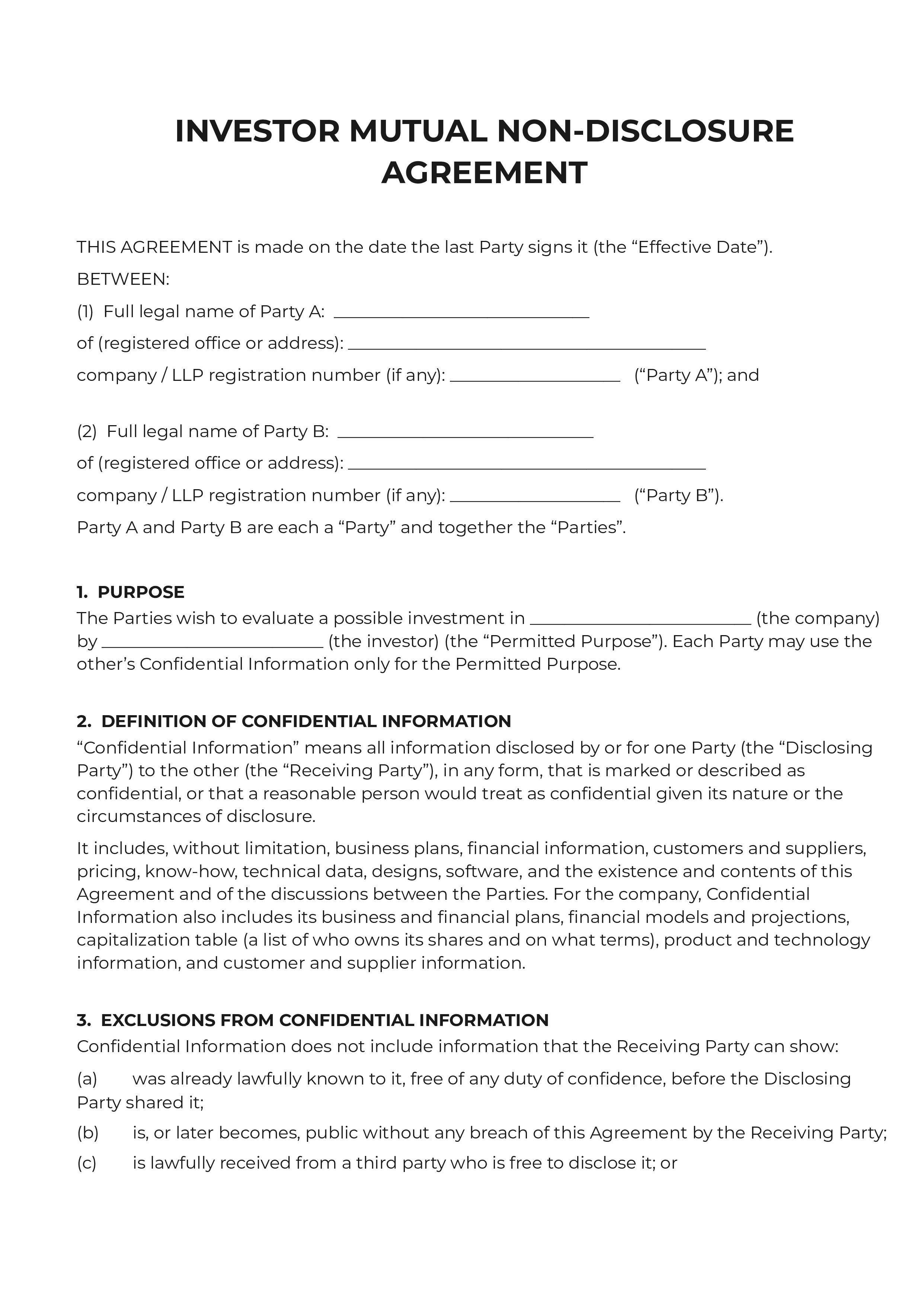
Investor Mutual Non-Disclosure Agreement (NDA)
ZenDocs is not a law firm and does not provide legal advice
ZenDocs is not a law firm and does not provide legal advice
An Investor mutual non-disclosure agreement (NDA) is a contract where both parties agree to keep each other's confidential information secret while an investment is being evaluated. It is built for a company and an investor: the company shares its business plans, financial models and projections, cap table and product information, and the investor shares what it needs to in return. Each side can be both the Disclosing Party and the Receiving Party.
Three main reasons: First, it sets a shared handling framework, so each party protects what the other discloses and uses it only for the Permitted Purpose, here the evaluation of a possible investment. Second, it gives you a defined scope: what counts as Confidential Information and what falls outside it. And third, it adds an investor-specific clause on no exclusivity and portfolio activities, so an investor can still look at other businesses, including competitors, as long as it does not use your Confidential Information to do so.
It's pretty straightforward with Zendocs:
The template sets out the Permitted Purpose, the definition of Confidential Information (for the company, this expressly includes business and financial plans, financial models and projections, the capitalization table, product and technology information, and customer and supplier information) and its exclusions, and each party's obligations as Receiving Party. It also covers permitted disclosures, data protection, no exclusivity, no licence or transfer of rights, no warranty, return or destruction of information, term and duration, remedies, and governing law and courts.
Companies raising investment and the investors evaluating them, whenever both sides expect to exchange sensitive information before any deal is agreed, such as financial models, projections and ownership details.
If only one party will be sharing confidential information, a unilateral NDA is the better fit. If you are exchanging technical material such as code or prototypes, the Technology/IP mutual NDA adds provisions designed for that.
The template uses two separate periods. The agreement itself runs from the Effective Date until an end date you enter or, if no date is given, until the Permitted Purpose is completed or abandoned. The confidentiality obligations then continue for the number of years you set after the agreement ends.
Once you've filled everything out in Zendocs, go to the signature step. You can sign straight away with our e-signature tool, or leave the block blank so the parties can sign later. Remember that the agreement is made on the date the last party signs it.
Choose your legal form
Browse the library or search to find the exact template you need
Answer simple questions
The guided editor turns your answers into a finished legal form
Sign your document
Sign, then download, print, or share your legal document instantly
1.Choose your legal form
Browse the library or search to find the exact template you need
2.Answer simple questions
The guided editor turns your answers into a finished legal form
3.Sign your document
Sign, then download, print, or share your legal document instantly