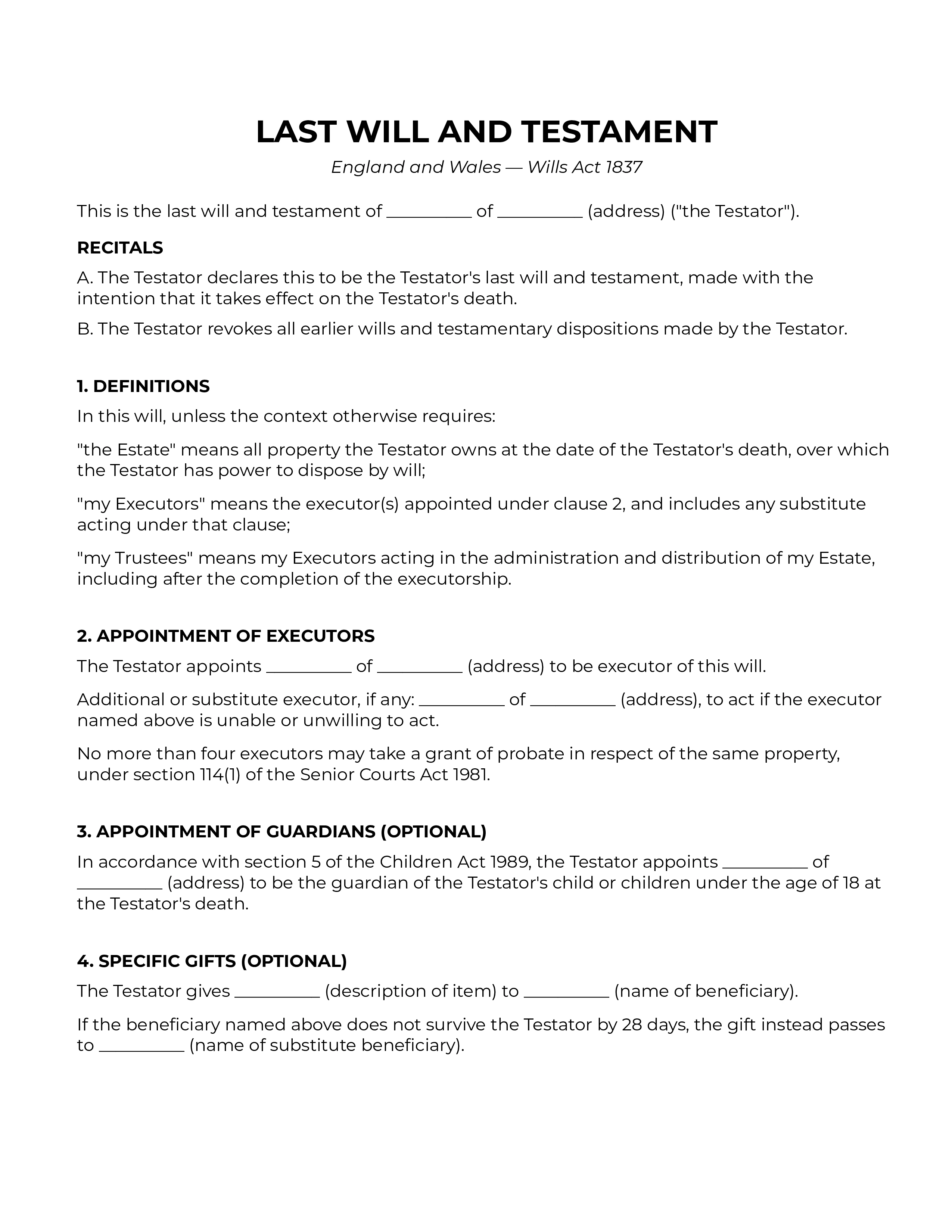
Last Will and Testament (England and Wales)
ZenDocs is not a law firm and does not provide legal advice
ZenDocs is not a law firm and does not provide legal advice
Reviewed by Zendocs Team. Updated 20 October 2026.
A last will and testament is a document made by one person, the testator, setting out how their estate is to be distributed after their death. It also appoints executors to administer the estate. This Zendocs template is written for England and Wales and is based on the Wills Act 1837.
A will gives you control over distribution, so your estate goes where you choose instead of following the fixed order of relatives under the statutory intestacy rules. It lets you name your own executors rather than leaving that to the court, address the guardianship of young children (which intestacy does not), and make targeted gifts to particular people alongside a residuary gift for everything else.
It's pretty straightforward with Zendocs:
The template revokes earlier wills, appoints executors, and includes optional guardianship, specific gift and pecuniary legacy clauses, each with a substitute-beneficiary option. It also has a residuary estate clause, administrative powers for your trustees, a 28-day survivorship clause, optional funeral wishes, a note on a separate letter of wishes, and a signature block with two witnesses.
Anyone who wants to decide who inherits, in whole or in part, rather than relying on the statutory intestacy rules. It is also useful if you want to appoint a guardian for a child under 18, appoint trusted executors to collect in assets, pay debts and expenses and distribute the estate, or record your personal wishes.
Yes. A will can be changed at any time before death, either by making a new will that revokes the earlier one or by a separate codicil, each signed and witnessed with the same formalities. Note that under section 18 of the Wills Act 1837, marriage automatically revokes an earlier will unless it was made in contemplation of that marriage and says so.
A will has no legal effect until death, which means you can update it as your circumstances change. After death, the named executor typically needs to obtain a grant of probate before dealing with most assets.
Under section 9 of the Wills Act 1837, the will must be signed by the testator (or by another person in their presence and at their direction), with that signature made or acknowledged in the presence of two witnesses present at the same time, who then each sign in the testator's presence. Zendocs lets you add the testator signature and witness details in the wizard, and you should make sure the witnesses are present when signing. A witness (or their spouse or civil partner) who is also a beneficiary will lose their gift, under section 15 of the Wills Act 1837.
Choose your legal form
Browse the library or search to find the exact template you need
Answer simple questions
The guided editor turns your answers into a finished legal form
Sign your document
Sign, then download, print, or share your legal document instantly
1.Choose your legal form
Browse the library or search to find the exact template you need
2.Answer simple questions
The guided editor turns your answers into a finished legal form
3.Sign your document
Sign, then download, print, or share your legal document instantly