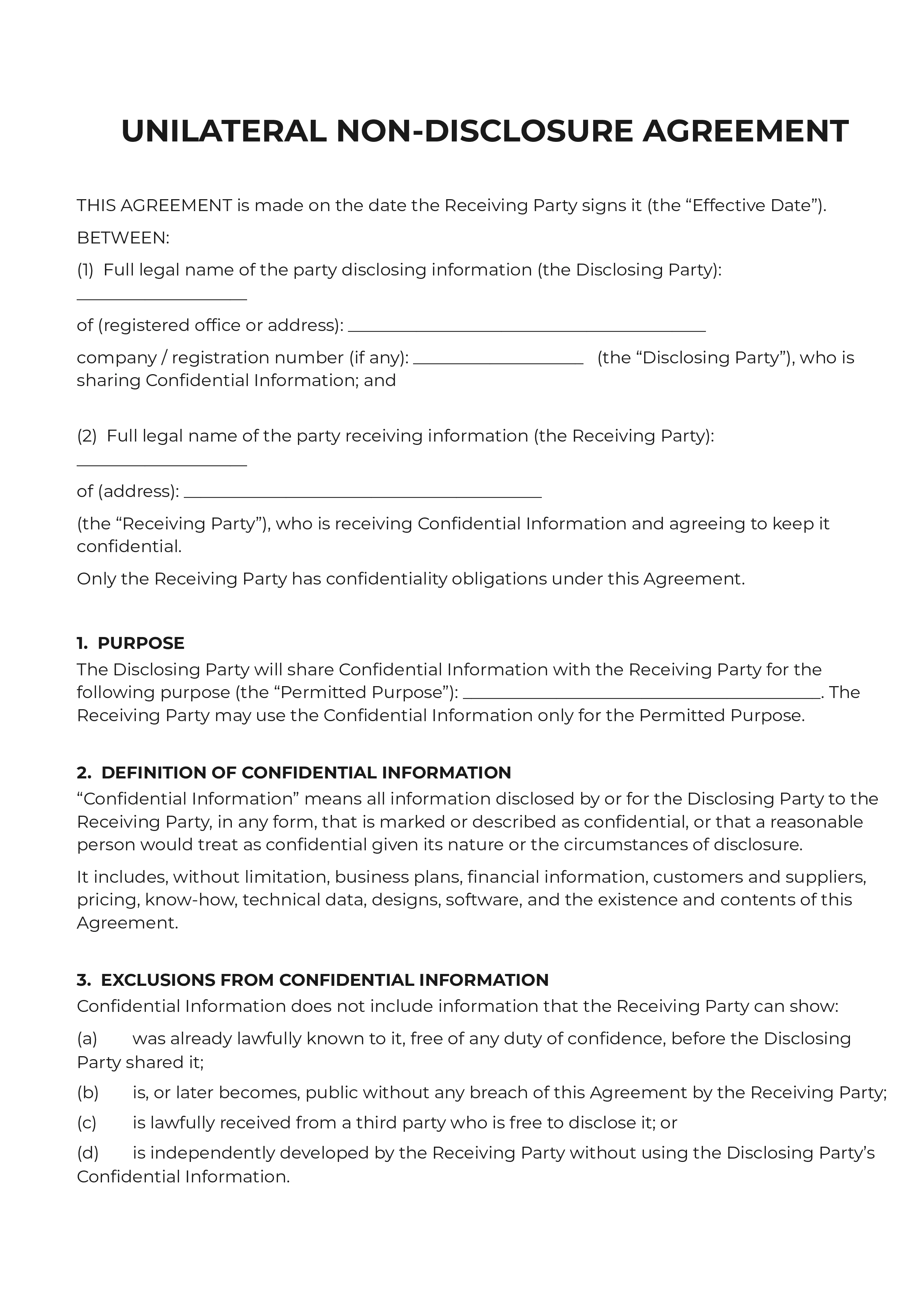
A unilateral non-disclosure agreement (NDA), also called a one-way NDA, is a contract where only one party shares confidential information and only the other party takes on the duty to protect it. The party sharing the information is the Disclosing Party; the party receiving it is the Receiving Party. Confidentiality duties run in a single direction: the Receiving Party is bound, while the Disclosing Party has no equivalent obligation under the agreement. Zendocs provides a ready-to-fill version for use in the UK.
Three main reasons: First, it gives you a single-direction obligation, so the party receiving your information is the one bound to protect it. Second, it sets a defined scope: what counts as Confidential Information, what falls outside it, and the Permitted Purpose it can be used for. And third, it deals with how the information can be shared onward, including permitted disclosures and disclosures protected by law.
It's pretty straightforward with Zendocs:
- Open the unilateral NDA in our editor
- Enter the details of the Disclosing Party, the one sharing the information
- Add the details of the Receiving Party (these can be left for the other party to complete later)
- State the Permitted Purpose for sharing the information
- Set when the agreement ends and for how many years the confidentiality obligations continue afterwards
- Choose the governing law, then sign now or leave the signature block for later
- Hit download and you're done!
The template sets out the Permitted Purpose, the definition of Confidential Information and its exclusions (information already lawfully known, public without breach, lawfully received from a third party, or independently developed), and the Receiving Party's obligations. It also covers permitted disclosures, disclosures protected by law, data protection, no licence or transfer of rights, no warranty, return or destruction of information, term and duration, remedies, and governing law and courts.
Anyone sharing confidential information one way: for example, a business evaluating an opportunity, engaging a service provider, or sharing technical or pitch material with someone who will not be sharing confidential information back.
If both parties will exchange confidential information, a mutual NDA is the better fit, because both sides then carry confidentiality obligations. A unilateral NDA only protects information flowing in one direction.
The template uses two separate periods. The agreement itself runs from the Effective Date until an end date you enter or, if no date is given, until the Permitted Purpose is completed or abandoned. The confidentiality obligations then continue for the number of years you set after the agreement ends.
Once you've filled everything out in Zendocs, go to the signature step. You can sign straight away with our e-signature tool, or leave the block blank so the parties can sign later. Remember that the agreement is made on the date the Receiving Party signs it.