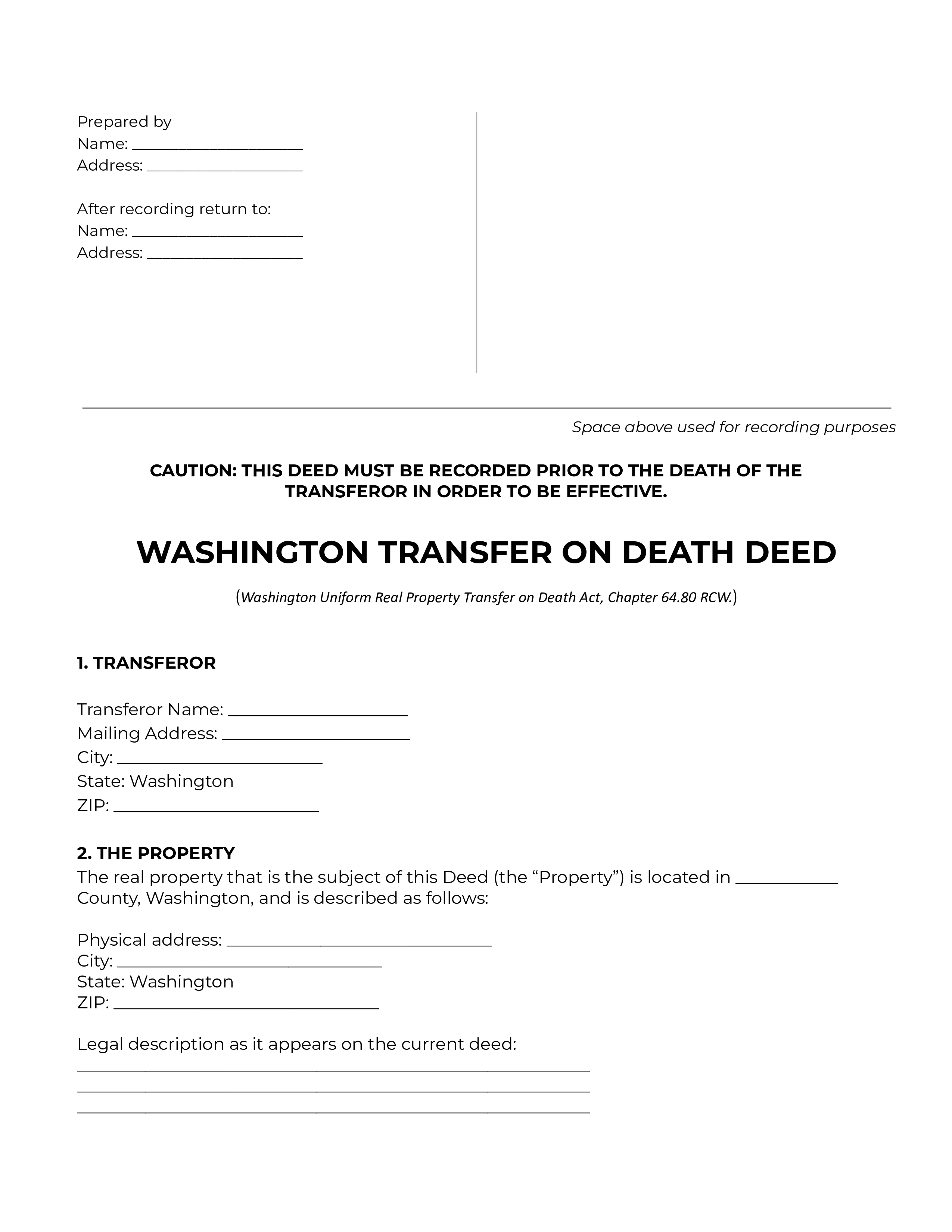
What is a Washington Transfer on Death Deed?
A transfer on death deed (sometimes called a TODD or beneficiary deed) is a document a property owner signs and records during their lifetime that names one or more beneficiaries to receive the property automatically at the owner's death. It is authorized by the Washington Uniform Real Property Transfer on Death Act, Chapter 64.80 RCW. The property stays entirely under the owner's control while they are alive — the owner can sell it, mortgage it, or change or revoke the deed — and nothing passes to the beneficiary until death. Because the transfer happens through the recorded deed rather than a will, the property covered by it generally passes outside probate. The deed takes effect only if it is recorded in the office of the auditor of the county where the property is located before the owner dies; one that is never recorded, or recorded only after death, has no effect.
When People Use It?
- When a Washington property owner wants their home or land to pass to a specific person at death without that property going through probate.
- When someone is doing estate planning and wants a simple, revocable way to direct a single piece of real estate.
- When an owner wants to keep complete control during life, including the ability to sell the property or revoke the deed at any time before death.
- When a person wants to name more than one beneficiary to share a property, and optionally an alternative beneficiary to take if no primary beneficiary survives.
Why People Use It?
- The property it covers generally passes outside probate.
- It can be revoked or changed at any time before death.
- The owner keeps full control during life — the beneficiary has no rights, no say, and does not need to be notified that the deed exists.
- It is a relatively simple, low-cost way to direct a single property compared with arrangements like a living trust.
What the Template Gives You?
- A complete Washington transfer on death deed structured around Chapter 64.80 RCW, with sections for the transferor, the property, the primary beneficiary or beneficiaries, an optional alternative beneficiary, and the transfer itself.
- A property section prompting the legal description as it appears on the current deed, which is the part that identifies the parcel for recording.
- Language that handles one beneficiary or several, including how the property is shared and what happens if a named beneficiary does not survive.
- A recording caution and a notary acknowledgment block, so the steps that make the deed effective are built into the document.